

A school should be a place where students focus on learning — not where administrators lie awake worrying about the next incident. Yet for many decision-makers in New York’s educational institutions, security is a persistent, evolving challenge that demands more than locked doors and surveillance cameras.
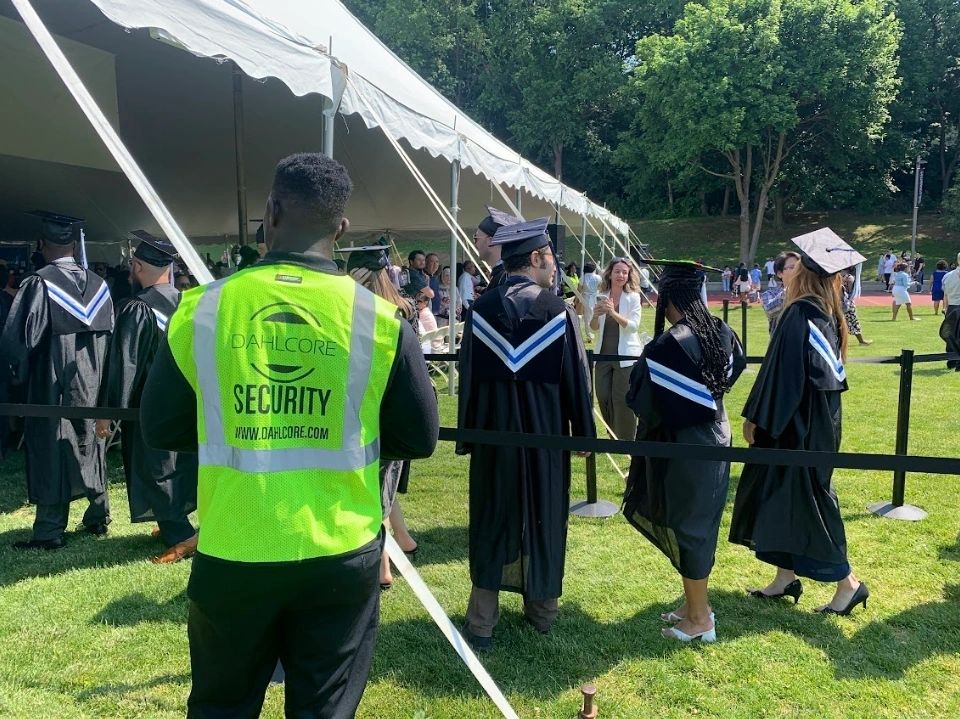
Security guards in schools and universities are often the most visible and responsive layer of a campus safety strategy. When deployed thoughtfully, they do far more than stand at an entrance. They build relationships, de-escalate conflicts, enforce policies, and serve as the first line of response when something goes wrong.
This guide is written for the school administrators, campus security directors, and university board members who are responsible for getting this right. We’ll cover what security guards actually do in educational settings, why their role matters specifically in New York, and how to integrate, budget for, and measure their effectiveness — practically, not theoretically.
Key Takeaways
- Security guards in schools serve critical functions beyond access control — including conflict resolution, emergency response, and community trust-building.
- New York has specific regulatory requirements governing school safety personnel that administrators must understand before hiring.
- The most effective campus security programs combine trained human guards with technology like CCTV, access control systems, and visitor management software.
- Budget constraints are real, but there are practical frameworks for justifying and structuring security guard costs.
- Integration into school culture — not just campus infrastructure — determines whether a security program actually works.
The Importance of Safety in Educational Institutions
Safety isn’t a background concern in education — it’s foundational. Students can’t learn effectively when they feel threatened. Teachers can’t teach when they’re anxious about their environment. And administrators can’t lead when they’re reacting to crises rather than preventing them.
New York’s educational institutions face a unique set of pressures. The state’s large urban school districts, dense university campuses, and diverse student populations create environments where security challenges are both high-stakes and varied. According to the New York State Education Department, school safety data is reported annually through the Violent and Disruptive Incident Reporting (VADIR) system, which tracks everything from minor altercations to more serious incidents.
Beyond physical safety, there’s an academic impact to consider. Research consistently shows that students in schools perceived as unsafe have lower attendance rates, reduced academic performance, and higher dropout risk [source needed]. For university administrators, campus safety directly affects enrollment decisions, student retention, and institutional reputation.
The question isn’t whether safety matters. It’s how to build systems that actually deliver it — sustainably, legally, and without turning a school into a fortress.
Understanding the Role of Security Guards in Schools and Universities
Not all security roles are the same. A security guard working at a retail complex operates very differently from one assigned to a middle school or a university campus. Understanding that distinction is critical before you hire, train, or deploy anyone.
In educational settings, security guards typically:
- Monitor and control access to buildings, campuses, and restricted areas
- Conduct regular patrols of grounds, parking lots, hallways, and common areas
- Respond to behavioral incidents, conflicts between students, and medical emergencies
- Enforce campus policies around prohibited items, trespassing, and visitor protocols
- Collaborate with local law enforcement during major incidents
- Write incident reports and document security-related events
- Serve as a visible, reassuring presence that deters potential bad actors
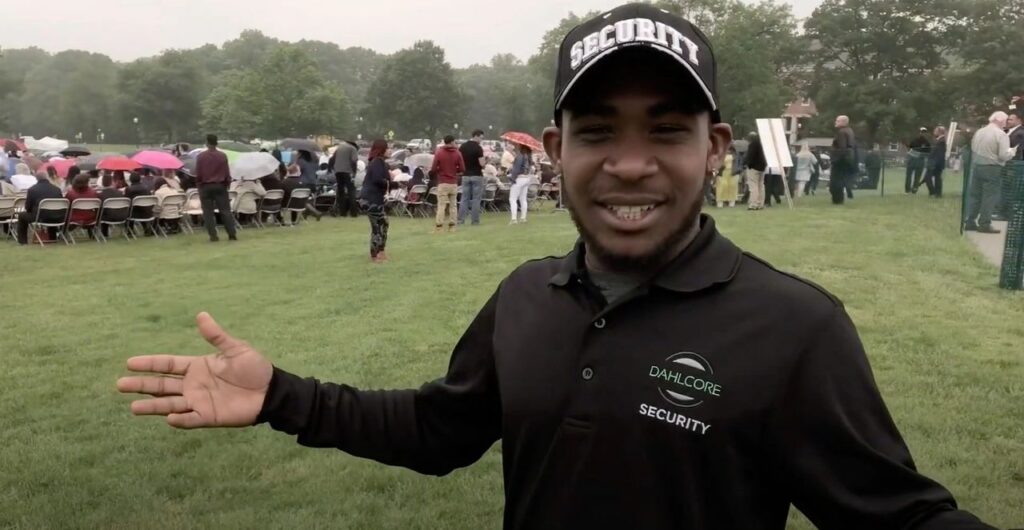
It’s also worth drawing a clear line between security guards and school resource officers (SROs). SROs are sworn law enforcement officers assigned to schools through agreements with local police departments. Security guards, by contrast, are civilians — typically employed through a private security firm like Dahlcore Security Guard Services or directly by the institution. Both roles have value, but they operate under different legal authorities and serve different functions.
For many New York schools and universities, a combination of both — or private security guards alone for campuses that don’t require sworn officers — represents the most practical approach.
Benefits of Security Guards in Schools and Universities
When the right person is in the right role, a security guard’s presence generates benefits that ripple across the entire campus.
1. Deterrence A uniformed, professional security presence signals that the campus takes safety seriously. Many low-level incidents — vandalism, trespassing, minor theft — are deterred simply by consistent visibility.
2. Rapid Incident Response When conflicts escalate or emergencies arise, the speed of initial response matters enormously. Security guards stationed on campus can respond in seconds, not minutes, compared to waiting for law enforcement to arrive. In active threat scenarios, those seconds matter.
3. Conflict De-escalation Well-trained school security guards aren’t just responders — they’re preventers. Guards who know the campus, recognize student behaviors, and have de-escalation training can intervene before a disagreement becomes a fight or a situation spirals.
4. Access Control Unauthorized visitors are one of the most underappreciated risks in school safety. Security guards managing entry points can verify identities, enforce sign-in protocols, and flag individuals who have no legitimate reason to be on campus.
5. Support for Emergency Protocols Security guards trained in emergency response procedures become essential assets during lockdowns, evacuations, or medical emergencies. They coordinate movement, communicate with first responders, and ensure protocols are followed correctly.
6. Improved School Climate Counterintuitive as it may seem, students and staff often report feeling more at ease — not less — when professional security personnel are present. A calm, visible guard communicates institutional care for the community.
Case Study: Security Guard Programs in New York Educational Institutions
New York City’s public school system operates one of the largest school safety programs in the country, managed primarily through the NYPD’s School Safety Division, which deploys School Safety Agents — a civilian peace officer role — across hundreds of schools citywide. This model demonstrates the scale at which professional security staffing can operate within an educational framework.
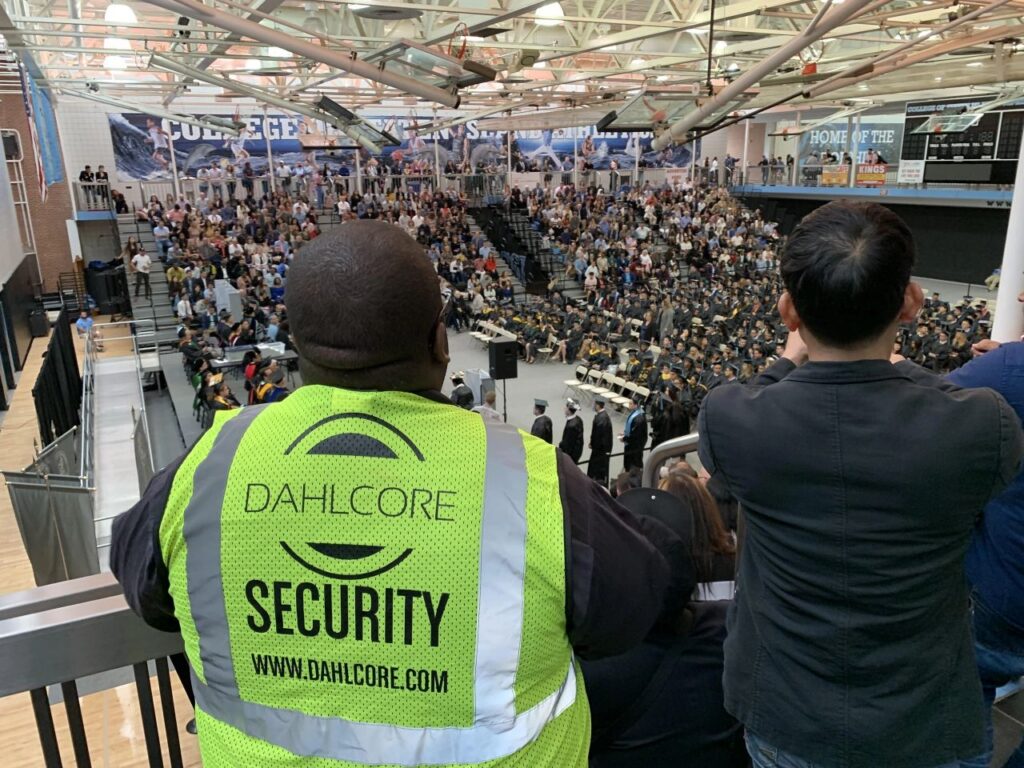
Beyond the public K-12 system, New York’s private schools and universities have increasingly moved toward professional private security firms to address gaps not covered by law enforcement partnerships. University campuses — particularly those in urban settings like Manhattan or Brooklyn — deal with open-campus challenges that require constant vigilance: managing access points where the public and student populations intersect, responding to incidents in dormitories, and securing large-scale events.
For example, a mid-sized private university in New York facing repeat incidents of trespassing and theft in its residence halls implemented a restructured security guard deployment: dedicated overnight guards on residential floors, improved check-in protocols at building entrances, and regular guard rotation throughout campus. The result was a measurable decrease in reported incidents and improved student satisfaction scores related to campus safety.
The takeaway from real-world programs like these: structured deployment, clear responsibilities, and ongoing training are what separate effective campus security from security theater.
Integrating Security Guards into School Culture
One of the most common mistakes educational institutions make is treating security guards as outsiders — uniformed staff who enforce rules but remain separate from the school community. That approach backfires.
When security guards are genuinely integrated into the campus community, trust develops. Students are more likely to report concerns to a guard they know. Staff are more likely to flag suspicious behavior if they have a direct relationship with security personnel. And guards who understand the specific culture and population of a campus make better judgment calls.
Practical integration strategies include:
- Orientation and relationship-building: Have guards attend staff orientations, meet with faculty, and participate in student-facing activities where appropriate.
- Clear communication channels: Establish direct lines between security staff, administration, and teachers so information flows quickly during incidents.
- Cultural competency training: Guards working in diverse New York school environments benefit significantly from training that addresses how to communicate respectfully across different cultural and linguistic backgrounds.
- Defined escalation protocols: Every guard should know exactly when to handle a situation independently versus when to escalate to administration or law enforcement.
- Regular debriefs: Weekly or monthly briefings between security staff and administration create accountability and surface problems early.
The goal is a security team that feels like part of the school, not an enforcement arm of it.
Legal and Regulatory Considerations in New York
Hiring security guards for a New York school or university isn’t simply a staffing decision — it involves navigating a specific legal and regulatory landscape.
Key points New York administrators need to know:
- New York State Security Guard Act: Under Article 7-A of the General Business Law, security guards in New York must be registered with the Department of State and meet specific training requirements, including an 8-hour pre-assignment training course and ongoing annual training.
- School Safety Plans: Under New York Education Law Section 2801-a, every public school district must develop a comprehensive district-wide school safety plan and building-level emergency response plans. The role of security personnel should be explicitly addressed within these plans.
- Background checks: All security personnel working in schools should undergo thorough background screening. New York State mandates fingerprinting and criminal history checks for many categories of school employees and contractors.
- Use of force policies: Educational institutions must have clear, written policies governing if and when security guards are authorized to use physical intervention, and guards must be trained accordingly.
- Liability considerations: Schools can face liability if a security guard’s actions — or failures to act — result in student harm. Proper documentation, training records, and incident reporting reduce this risk significantly.
Working with a reputable, licensed security firm like Dahlcore Security Guard Services that understands New York’s specific requirements is one of the most effective ways to ensure compliance from day one.
Budget Considerations and Cost-Effectiveness
Security is one of those line items that feels expensive until you calculate the cost of not having it. A serious incident — and the legal, reputational, and human costs that follow — can dwarf years of security guard expenditures.
That said, budget constraints in educational institutions are real, and administrators need practical frameworks for allocating resources wisely.
Strategies for making school security cost-effective:
- Risk-based deployment: Not every part of a campus needs the same level of coverage. Conduct a security audit to identify your highest-risk areas and time periods, then concentrate guard hours there.
- Blend contract and in-house staffing: Many institutions find that contracting through a security firm for peak hours or events, while maintaining a smaller permanent in-house team, provides flexibility without overspending.
- Layer with technology: Security guards supplemented by CCTV, access control, and alarm systems can cover more ground effectively — meaning you may need fewer guards to achieve equivalent coverage.
- Multi-year contracts: Longer-term contracts with security firms often yield better pricing and staffing consistency.
- Measure ROI: Track incidents before and after implementation. Reduced incidents, lower insurance premiums, and improved student retention all have quantifiable dollar values that can justify security costs to boards and stakeholders.
Innovative Technologies in School Security
Technology doesn’t replace a well-trained security guard — but it extends what that guard can do.
The most impactful technologies in current school security deployments include:
- CCTV and video monitoring: Camera systems allow guards to monitor multiple locations simultaneously and provide documented records of incidents. Modern AI-powered systems can flag unusual activity automatically.
- Access control systems: Key card, fob, or biometric entry systems restrict access to sensitive areas and create audit trails showing who entered or exited specific buildings.
- Visitor management software: Digital check-in systems that screen visitors against sex offender registries and issue temporary badges have become standard in many New York school districts.
- Two-way radios and communication platforms: Reliable, encrypted communication between guards, administration, and local law enforcement is essential during incidents.
- Mass notification systems: Tools that allow simultaneous alerts to staff, students, and parents via text, email, and PA systems enable rapid coordinated response during emergencies.
The most effective school security operations treat technology and human personnel as a system, not separate solutions. A guard who can see a camera feed, communicate instantly, and lock down an access point remotely is significantly more effective than one operating without those tools.
Conclusion and Recommendations
Security guards in schools and universities aren’t a luxury — in today’s environment, they’re a strategic necessity. But effectiveness depends entirely on how they’re selected, trained, deployed, and integrated.
For New York educational institutions evaluating or improving their security programs, here’s a practical starting framework:
- Conduct a security audit of your current campus before making any staffing decisions.
- Define clear roles and responsibilities for security personnel in writing.
- Ensure full compliance with New York State security guard registration and training requirements.
- Integrate guards into your school safety plan and emergency response protocols explicitly.
- Choose a security partner with demonstrated experience in educational environments, like Dahlcore Security Guard Services.
- Measure outcomes — don’t just deploy and forget. Set baseline metrics and track them.
A well-run security program doesn’t make a school feel like a prison. It makes it feel like a place where the people in charge genuinely care about the community they serve.
Is your school’s security program built for today’s challenges? Contact Dahlcore Security Guard Services to schedule a confidential campus security consultation tailored to your institution’s needs.
FAQs
What impact do security guards have on student safety?
Security guards reduce incidents through both deterrence and direct response. Their presence discourages unauthorized access and aggressive behavior, while their training prepares them to intervene quickly and appropriately when situations escalate. Beyond physical safety, students and staff often report higher feelings of security and well-being when professional guards are consistently present.
How do security guards fit into a school’s emergency response plan?
Security guards should be explicitly named and given defined roles within every school’s emergency response plan. This includes responsibilities during lockdowns (securing entry points, communicating with law enforcement), evacuations (directing traffic flow, accounting for students), and medical emergencies (providing first aid and meeting emergency responders). If your current safety plan doesn’t specify guard roles, that’s a gap worth addressing immediately.
Are security guards necessary in small educational institutions?
Size doesn’t eliminate risk — it changes its character. Smaller schools and universities may face different threats than large urban campuses, but incidents still occur. For smaller institutions with budget constraints, part-time guards, event-based security, or shared security services with neighboring institutions can be practical alternatives to full-time staffing.
What training do security guards need to work in schools?
At a minimum, guards working in New York schools must meet the state’s registered security guard training requirements under Article 7-A. Beyond legal minimums, school-specific security guards benefit from training in de-escalation techniques, trauma-informed approaches, cultural competency, emergency response procedures (including active threat response), and adolescent or young adult behavioral dynamics.
How can schools measure the effectiveness of their security personnel?
Effective measurement includes tracking reported incidents over time, response time data, visitor management compliance rates, staff and student safety perception surveys, and near-miss or incident prevention reports filed by guards. Comparing data before and after implementing a security program — or after making changes — gives administrators concrete evidence of what’s working.
What’s the difference between a school security guard and a school resource officer?
A school resource officer (SRO) is a sworn law enforcement officer assigned to a school through a formal agreement with a police department. They carry arrest authority. A security guard is a civilian who operates under different legal authority and is typically employed through a private firm or directly by the institution. Both roles serve valuable but distinct functions. Many campuses benefit from having both.
How should schools handle situations where security guards and students have conflicts?
Clear use-of-force policies, documented escalation procedures, and communication between security leadership and school administration are essential. Any serious conflict should be documented, reviewed, and used as a training opportunity. Guards who receive regular feedback — and who are genuinely integrated into the school community — are far less likely to generate these conflicts in the first place.
