

HOA Security Guards vs. Private Patrol Services: Deciding What’s Right for Your NY Community
Your HOA board has just wrapped up its quarterly meeting, and the topic that dominated the last 45 minutes wasn’t the landscaping budget or the parking rules — it was security. A few incidents in the neighborhood, some concerned residents, and suddenly, everyone has an opinion. Do you hire a dedicated security guard? Sign a contract with a private patrol company? Or some combination of both?
If this sounds familiar, you’re not alone. Security decisions are among the most consequential — and most misunderstood — choices HOA boards and property managers make. Get it right, and your community feels safer, property values hold strong, and residents trust their leadership. Get it wrong, and you’re either overpaying for a service that doesn’t fit your needs or leaving gaps that create real risk.
This guide cuts through the noise. We’ll break down HOA security guards vs. private patrol services from every practical angle — cost, coverage, flexibility, and effectiveness — so your board can make a confident, informed decision for your New York community.
Understanding Community Security Needs
Before you can choose between a guard and a patrol, you need to get honest about what your community actually requires. Security isn’t one-size-fits-all, especially across New York’s wildly different neighborhoods — from gated suburban developments on Long Island to dense residential complexes in Queens or the Hudson Valley.
Start with these core questions:
- How large is your community? A 50-unit condo building has very different coverage needs than a 400-home planned development.
- What’s the local crime profile? Check NYPD precinct data or county crime reports to understand whether your area faces issues with vehicle break-ins, trespassing, package theft, or more serious incidents.
- What do residents actually expect? Some communities want a visible, uniform presence. Others want discreet monitoring. Misaligning the security model with resident expectations creates friction.
- Do you have a gatehouse, common areas, or specific vulnerable points? A fixed access point almost always calls for a stationed guard. A sprawling community with multiple entry roads may benefit more from mobile patrol coverage.
Getting clear on these factors first saves your board from making a decision based on price or habit rather than actual need.
HOA Security Guards: An In-Depth Look
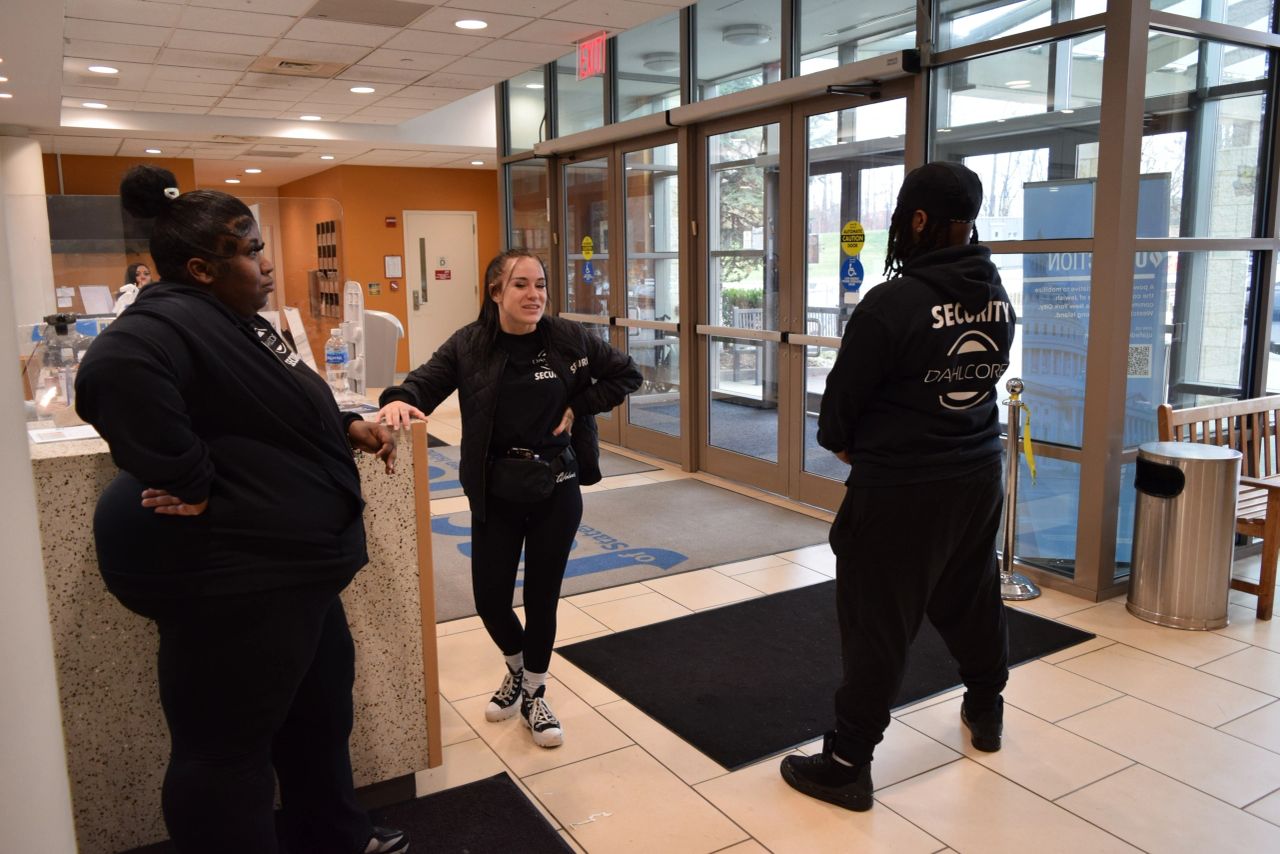
A dedicated HOA security guard — sometimes called a stationed or fixed-post guard — is assigned to a specific location within your community. Think of the guard at a gatehouse checking vehicles in and out, or a uniformed presence in a lobby or common area.
What They Do Well
- Access control: Guards can verify identity, log visitors, and enforce community entry policies consistently.
- Immediate visible deterrence: A uniformed guard is one of the strongest crime deterrents available. Opportunistic criminals look for easy targets — a visible presence eliminates that.
- Resident relationship building: Over time, a regular guard gets to know residents, notices when something is off, and becomes a trusted part of the community.
- Incident response: A stationed guard can respond immediately to a dispute, medical emergency, or suspicious activity without waiting for someone to arrive on scene.
Where They Fall Short
- Coverage area is limited: One guard can only be in one place. If your community spans multiple blocks or acres, you’ll have blind spots.
- Cost at scale: Full-time, around-the-clock guard coverage requires multiple shifts, which means multiple guards — and that adds up fast.
- Downtime: Guards on a fixed post may have hours with minimal activity, which some HOA boards perceive as inefficient.
Best fit: Gated communities, high-rise residential buildings, developments with a single main entrance, or communities where resident-facing interaction is a priority.
Private Patrol Services: What They Offer
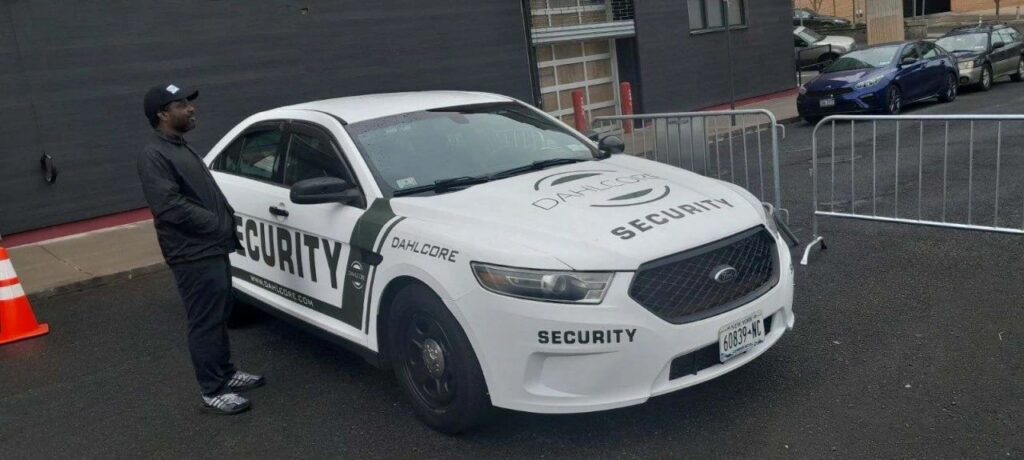
Private patrol services operate differently. Instead of staying in one spot, patrol officers move through a defined area on a set or randomized schedule — driving or walking routes through your community, checking common areas, parking lots, perimeter fences, and other vulnerable points.
What They Do Well
- Broader coverage: One patrol officer can cover significantly more ground than a stationed guard, making this option practical for larger communities.
- Unpredictability as a deterrent: Randomized patrol routes are harder for would-be criminals to anticipate, which strengthens deterrence.
- Flexibility: Patrol schedules can be adjusted based on incident history, seasonal needs, or community events.
- Cost efficiency for large areas: You get eyes across the full property without paying for multiple fixed-post guards.
Where They Fall Short
- No permanent presence: Because the patrol is mobile, there’s no one stationed at the gate or lobby. If a situation arises between patrol passes, there may be a gap in response.
- Less resident familiarity: Patrol officers rotate more frequently, so residents rarely develop the same rapport as they would with a dedicated guard.
- Variable response time: Depending on where the officer is in their route, response to a specific location may take several minutes.
Best fit: Large residential communities, open developments without a gatehouse, communities that need wide-area coverage without a fixed entry point, or HOAs supplementing an existing security system.
Cost Comparison: Guards vs. Patrols
Cost is always a real factor for HOA boards working within a set budget. Here’s a practical breakdown of how these two options compare financially.
HOA Security Guards are typically billed by the hour, per post. Rates in New York vary based on guard certification level, shift time (overnight rates are often higher), and contract length. A single guard covering a daytime shift five days a week represents a meaningful line item — multiply that for evening or overnight coverage, and you’re looking at a significant annual commitment.
Private Patrol Services generally cost less per hour than a dedicated guard because the time and attention are distributed across multiple clients or a wider area. However, the per-visit or per-hour contract structure varies widely by provider and scope.
Key budget considerations:
- Do you need 24/7 coverage or targeted hours (evenings, weekends)?
- Can you combine technologies — cameras, intercoms — with a patrol to reduce hours needed?
- What’s the cost of not having adequate security? Factor in liability, property damage, and resident turnover.
A hybrid model — stationed guard during peak hours, patrol coverage overnight — often delivers the best value for mid-to-large communities.
Customization and Flexibility in Security Services
One of the most overlooked factors in the HOA security guards vs. private patrol conversation is how adaptable each option is to your community’s evolving needs.
Security guards can be briefed on specific community rules, resident concerns, and HOA policies. A good guard becomes an extension of your management team — enforcing parking rules, managing vendor access, and flagging maintenance issues.
Patrol services offer scheduling flexibility that’s harder to achieve with a stationed guard. Need extra coverage during a community event? Increased patrols after a string of car break-ins? Most patrol providers can adjust frequency and routes without the friction of hiring additional staff.
The best security providers — like Dahlcore Security Guard Services — work with HOA boards to develop customized security plans that combine both approaches as needed. Security shouldn’t be a static contract. It should evolve as your community grows and as threat patterns change.
Ask any provider you’re considering: Can you adjust coverage on short notice? Do you offer hybrid models? How do you communicate with HOA management? The answers reveal whether they treat you as a partner or just a billing account.
Case Study: Successful Security Implementation
Consider a mid-sized planned residential community in Nassau County with roughly 200 homes, multiple entrances, a community clubhouse, and a history of package theft and occasional trespassing near the rear perimeter.
The HOA board initially contracted a single-stationed guard at the main entrance, which helped with access control but left the rear of the community unmonitored. After a series of incidents near the back fence line, the board reassessed.
Working with their security provider, they implemented a hybrid model: a stationed guard at the main gate during daytime hours (7 AM–7 PM), paired with a private patrol service covering evening and overnight hours across the full perimeter. They also added motion-activated lighting near the rear access points.
Within the first quarter, reported trespassing incidents dropped noticeably, and resident satisfaction with security — measured via their annual HOA survey — improved significantly. The hybrid approach costs less than adding a second full-time guard while covering far more ground.
Note: This example is illustrative of a common hybrid security implementation pattern. Specific results will vary by community.
Risk Management and Security Effectiveness
From a risk management standpoint, the question isn’t just “which option is cheaper?” — it’s “which option reduces our liability and keeps residents safe?”
Stationed guards excel in situations requiring immediate, on-site response. An altercation at the gate, a medical emergency in the lobby, or a confrontation between residents — these scenarios benefit enormously from having someone already on-site who can intervene, call for help, and document the incident.
Patrol services are stronger at detecting problems before they escalate. A patrol officer who notices a broken perimeter gate, an unfamiliar vehicle parked overnight, or signs of tampering with community infrastructure can flag issues before they become incidents.
Both options, when properly managed, contribute to a layered security strategy. The risk of relying on only one approach is creating predictable gaps — either in coverage area (fixed guard) or in response time (mobile patrol). The most effective security plans combine human presence with technology and clear escalation protocols.
Step-by-Step Guide to Choosing the Right Security Service
Use this practical framework to guide your board’s decision-making process.
Step 1: Conduct a Security Audit. Walk your property with fresh eyes. Identify entry points, blind spots, high-traffic common areas, and historically problematic locations. Document everything.
Step 2: Review Incident History Pull records of past security incidents — reports filed with management, police reports, and resident complaints. Look for patterns in time of day, location, and type of incident.
Step 3: Define Your Coverage Requirements. Based on your audit, determine what hours and areas need coverage. Be specific: We need 24/7 gate coverage and overnight perimeter monitoring.
Step 4: Set a Realistic Budget Range. Work with your HOA treasurer to establish what the community can sustainably spend on security. Include room for technology integrations (cameras, intercoms) that can extend the value of human coverage.
Step 5: Request Proposals from Multiple Providers. Get at least three proposals. Ask each provider to address your specific audit findings, not just hand you a standard package. Look for providers licensed in New York State and familiar with residential HOA environments.
Step 6: Evaluate Beyond Price Compare response time guarantees, supervision protocols, reporting practices, insurance coverage, and guard training standards. Ensure the agency fully complies with Article 7-A of NY General Business Law. In New York, security guards must be licensed through the NYS Division of Licensing Services — verify this for any provider you’re considering.
Step 7: Check References Ask for references from other HOAs or residential communities, not just commercial clients. The skill set and priorities are different.
Step 8: Start with a Trial Period. If possible, negotiate a 90-day trial before committing to a long-term contract. This gives you real-world data on performance, communication, and fit.
Step 9: Build in a Review Cycle. Security needs to change. Build quarterly or semi-annual reviews into your contract so coverage can be adjusted as your community evolves.
Conclusion and Recommendation
There’s no universal answer to the HOA security guards vs. private patrol services question — and any security provider that tells you otherwise isn’t listening to your needs.
What we can say with confidence: smaller, gated communities or buildings with a defined entry point are usually best served by stationed guards. Larger, open communities with multiple access points and wide common areas often get better value from patrol services — or a hybrid model that combines both.
In New York, where neighborhood dynamics shift block by block and community expectations run high, the right security solution is one that’s built around your specific reality. Dahlcore Security Guard Services specializes in exactly this kind of customized, community-first approach — helping HOA boards and property managers across New York design security strategies that actually work.
Ready to build a smarter security strategy? Speak directly with a Dahlcore security expert. We work with HOAs and residential communities across New York to design coverage that actually fits. Book a Consultation Today
FAQs
1. What is the main difference between HOA security guards and private patrol services?
HOA security guards are stationed at a fixed location — like a gate or lobby — providing access control and immediate on-site response. Private patrol services are mobile, covering a broader area on scheduled or randomized routes. Guards provide depth of coverage in one spot; patrols provide breadth across a larger area.
2. Which security service is more cost-effective for a community?
It depends on your community’s size and coverage needs. Patrol services often cost less per hour because coverage is distributed over a wider area, but they don’t provide the same on-site response capability as a stationed guard. Many communities find a hybrid model — guards during peak hours, patrols overnight — delivers the best balance of cost and coverage.
3. Can security services be tailored to individual community needs?
Yes, and they should be. Reputable providers like Dahlcore Security Guard Services develop customized security plans based on your community’s layout, incident history, budget, and resident expectations. Be cautious of any provider that offers only a standard package without first understanding your specific situation.
4. How do I know which security option is suitable for my HOA in NY?
Start with a security audit of your property, review your incident history, and clarify what hours and areas need coverage. From there, request proposals from licensed New York security providers and compare them against your specific requirements — not just on price, but on training standards, reporting practices, and supervisory oversight.
5. What are the typical challenges communities face with security services?
Common challenges include inadequate coverage during shift changes, poor communication between security staff and HOA management, high guard turnover, and services that aren’t adjusted as community needs change. Establishing clear performance expectations and regular review cycles in your contract helps address most of these issues proactively.
6. Are private patrols more effective than security guards?
Neither is inherently more effective — they serve different functions. Patrols are more effective for wide-area deterrence and detection. Guards are more effective for access control and immediate incident response. Effectiveness depends entirely on how well the service model matches your community’s actual security needs.
7. What are the costs of private patrol services in NY?
Patrol service costs in New York vary based on coverage hours, patrol frequency, area size, and provider. Rates are typically quoted per hour or per visit. We recommend getting multiple proposals from licensed NY providers and comparing the total annual cost against the coverage scope rather than focusing solely on the hourly rate.
8. Why is security important for HOAs?
Security directly affects property values, resident satisfaction, and the HOA’s legal liability. A well-secured community reduces the likelihood of incidents, protects the board from negligence claims, and creates an environment where residents feel confident in their investment. For New York communities — where real estate values are significant, and competition between developments is real — security quality is a meaningful differentiator.
