

Updated Date: March 17, 2026
What Security Guards Can and Can’t Do
Security guards deter crime, protect people and property, manage access, and document incidents, but their legal powers are firmly limited to private-citizen authority with specific allowances like shopkeeper’s privilege or a narrow citizen’s arrest in some situations. The core rule is simple: observe, deter, and safely detain when clearly lawful, then call police quickly and hand over the scene, evidence, and reports.
Guard vs. Police Authority
Security guards are private employees who generally share a private person’s arrest powers and cannot exercise the full criminal law enforcement authority of police officers. Their duties emphasize prevention, visibility, communication, documentation, and limited detention pending police arrival, not conducting searches without consent or completing arrests and investigations like sworn officers.
Access Control and Removal of Trespassers
On private property, guards can verify credentials, enforce house rules, and deny entry to those who refuse screening or violate conditions of entry established by the owner or event organizer. Guards may direct trespassers to leave and, if necessary, escort them off private premises using only reasonable, minimal force while preparing to call police if the person refuses to comply or escalates.
Consent-Based Searches and Screening
Searches of persons, bags, or belongings require clear, voluntary consent or must be tied to conditions of entry on private property, such as bag checks at an event gate, and refusal can mean refusal of entry rather than forced search. Even where a shopkeeper’s privilege applies, any search must be reasonable in scope, focused on property in a suspect’s immediate possession, and never a clothing search like police might conduct under a warrant.
Shopkeeper’s Privilege: Retail Detention Rules
In states like California, shopkeepers’ privilege allows merchants and their agents to detain suspected shoplifters for a reasonable time to investigate based on probable cause, using only reasonable, non-deadly force, typically until police arrive. The detention is narrowly tailored to the suspected theft, and overlong holds, clothing searches, or unnecessary force can trigger false imprisonment exposure and civil or criminal liability.
Citizen’s Arrest: Narrow and Risky
A security guard may perform a private person’s arrest only when strict elements are met, such as witnessing a qualifying crime, and even then, the guard must use minimal force and promptly summon law enforcement. Because mistakes can lead to false imprisonment claims, clear company policy should restrict citizens’ arrests to defined scenarios and require immediate notification to police and supervisory review.
Use of Force: Objectively Reasonable Only
Use of force must be proportional to the threat and grounded in an objectively reasonable standard, with de-escalation and communication prioritized before any physical intervention. Expert guidance and recent statutes highlight that reasonable, non-deadly force may be used in limited contexts like stopping theft under merchant statutes, while excessive or punitive force is prohibited and actionable.
Firearms, Batons, and Specialized Equipment
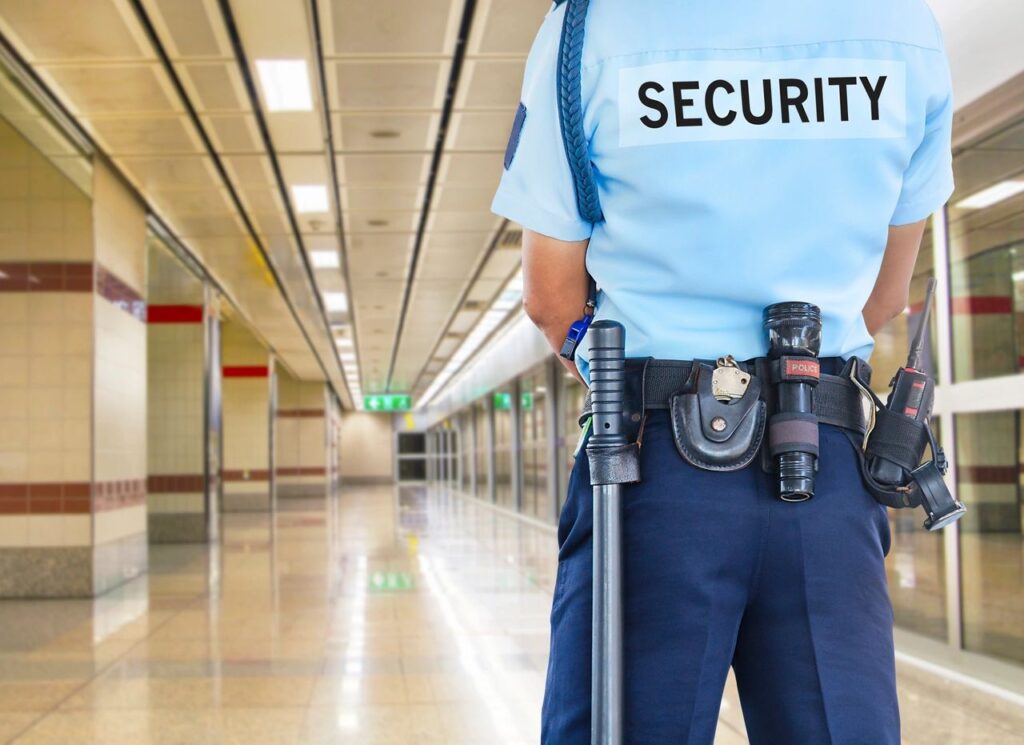
Carrying firearms or certain defensive tools typically requires specific licensing, permits, and training under state law and agency rules, along with strict policy controls and ongoing qualification. Unarmed security remains the norm in many settings, while armed assignments demand higher standards of supervision, documentation, and force reporting to meet regulatory expectations.
Off-Property Authority and Traffic Stops
Security authority is tied primarily to the property under protection, and guards do not have general public enforcement powers like traffic stops on public roads or pursuits beyond property boundaries. If a suspect flees off-site, guards should shift to observation, evidence preservation, and prompt coordination with law enforcement rather than self-initiating off-property enforcement.
Detaining People: Time Limits and Handoffs
Detention must be for a reasonable time and purpose—usually limited to stabilization and waiting for police—and indefinite or punitive detentions are unlawful. A best-practice protocol is to call police immediately upon a lawful detention, control the scene safely, communicate clearly with the detainee, and preserve evidence until officers arrive.
Identification, Professionalism, and No Impersonation
Guards should display credentials or distinctive uniforms and must never imply they are police or use police-specific phrases that suggest official arrest authority beyond a private person’s detention. Professional conduct policies should also cover bias awareness, communication standards, reporting requirements, and the duty to intercede when witnessing improper force by colleagues.
Evidence Handling and Incident Reporting
Preserve relevant video, logs, items, and witness statements and maintain a chain of custody where possible, then transfer both detainee and evidence to the police with a clear factual report. Good reports document observations, timelines, grounds for detention, force used (if any), and all notifications to supervisors and law enforcement to ensure defensibility.
2026 Training and Compliance Essentials
Regulators like California’s BSIS require a structured “Powers to Arrest” and use-of-force curriculum, minimum training hours, and annual refreshers that emphasize de-escalation, bias awareness, and scenario-based decision making. Keeping training current with 2023–2026 updates strengthens safety, reduces liability, and ensures alignment with modern use-of-force standards and duty-to-intercede expectations.
Local Law Example: California PC 490.5
California codifies shopkeeper’s privilege, allowing detention on probable cause, limited non-deadly force, examination of items, and strictly reasonable time windows, which retailers should reflect in SOPs and signage. The distinction from a citizen’s arrest matters, as merchant detentions focus on investigating suspected theft, not broader policing, and deviations can trigger false imprisonment risks.
How To: Build a Compliant Guard SOP in 7 Steps
- Define scope and property rules: Write clear conditions of entry, signage, and trespass directives aligned to local law and client policies.
- Set consent-based screening: Standardize bag checks, refusal consequences, and respectful scripts for event or facility entry points.
- Codify detention thresholds: Require probable cause or firsthand observation where applicable, and mandate an immediate police call on any detention.
- Force policy and de-escalation: Adopt the “objectively reasonable” standard, emphasize verbal tactics, and detail non-deadly options and reporting.
- Weapons governance: Specify licensing, permits, storage, qualification, and supervisory review for armed assignments and restricted tools.
- Evidence and reports: Standardize incident templates, evidence preservation, chain of custody, and timely supervisor and police notifications.
- Training cadence: Track initial and annual training, scenario drills, duty-to-intercede modules, and post-incident reviews to close learning loops.
Comparison: Guard Powers vs. Limits
Searches
- Can Do : Request consent-based bag checks and event screening tied to entry conditions
- Can’t Do: Search a person without consent or conduct clothing searches like police
Detention
- Can Do : Briefly detain under shopkeeper’s privilege or narrow citizen’s arrest, then call police
- Can’t Do : Detain indefinitely or for punitive reasons
Force
- Can Do : Use reasonable, non-deadly force proportionate to threat, with de-escalation first
- Can’t Do : Use excessive, retaliatory, or deadly force in typical property protection tasks
Firearms
- Can Do : Carry only with required licensing, permits, and training
- Can’t Do : Carry without permits or beyond scope/policy
Off-property
- Can Do : Secure site, observe, report, and coordinate with police
- Can’t Do : Conduct traffic stops or pursue off property like police

FAQs
What security guards can and can’t do at store exits?
Guards can request consent-based bag checks tied to entry conditions or store policy, and refusal may mean refusal of entry or calling police, not forced searches.
Can security guards arrest you?
They can perform a narrow citizen’s arrest or merchant detention when strict conditions are met, then must call police immediately and use only minimal, reasonable force.
Can guards detain someone indefinitely?
No, detention must be reasonable in duration and purpose, typically only until police arrive, and prolonged or punitive holds risk false imprisonment claims.
Do weapons rules change?
Yes, armed assignments require specific licensing, permits, training, and stricter oversight on use-of-force reporting and supervisory review.
How does the shopkeeper’s privilege fit into what security guards can and can’t do?
It allows reasonable, non-deadly detention on probable cause to investigate suspected theft, focusing on items and quick police handoff, not full-blown arrests.
Are traffic stops part of what security guards can and can’t do?
No, conducting traffic stops off property is outside authority; guards should observe, document, and coordinate with law enforcement instead.
Can guards refuse entry under what security guards can and can’t do?
Yes, on private property, they can deny entry for policy violations like refusing screenings or presenting no ID, provided rules are lawful and clearly communicated.
Local Notes and 2026 Trends
California’s BSIS training manual underscores de-escalation, scenario work, and objective reasonableness in force decisions, reflecting modern standards that many states mirror in 2026. California Penal Code 490.5 remains a retail cornerstone for lawful detentions, and policies aligning with its “reasonable time and manner” standard reduce risk amid persistent retail theft concerns.
Conclusion
The winning playbook for What Security Guards Can and Can’t Do is consistent: use consent-based screenings, detain narrowly and briefly when lawful, apply only reasonable force with de-escalation first, and call police fast while preserving evidence and documenting thoroughly. Strong 2026 training and clear SOPs turn those principles into daily habits that keep people safe and organizations out of legal trouble. Book consultation: Get a site-specific policy and training tune-up for 2026 standards.
