


A Property Owner’s Guide to Security for Residential Lofts and Mixed-Use Buildings in Tribeca
Tribeca has one of the most distinctive real estate profiles in New York City. Former warehouses converted into luxury lofts. Ground-floor retail anchored beneath floors of residential units. Loading docks that once served commercial tenants now sit beside doorman lobbies. The neighborhood’s architectural identity is its greatest appeal — and one of its biggest security challenges.
For property owners and managers, this mix creates a layered problem. You’re not just protecting a residential building or a commercial space. You’re protecting both, simultaneously, with overlapping foot traffic, multiple entry points, and tenants whose expectations and needs don’t always align.
This guide is built specifically for that reality. Whether you manage a single converted loft building on Franklin Street or a multi-tenant mixed-use property near Hudson Square, you’ll find actionable guidance here — informed by real-world experience from Dahlcore Security Guard Services.
Understanding Tribeca’s Security Landscape
Tribeca sits at the intersection of several competing dynamics that directly affect property security.
High foot traffic, low visibility. The neighborhood draws tourists, restaurant crowds, film industry professionals, and high-net-worth residents. That diversity makes it harder to identify who belongs in a building and who doesn’t. A person in a tailored coat walking into a loft lobby fits the visual profile of a resident. So does someone casing the place.
Architectural legacy creates access vulnerabilities. Many Tribeca loft buildings were designed for industrial use, not residential security. Wide freight elevators, multiple service entrances, and older door frames weren’t built with controlled access in mind. Retrofitting them for modern security requires planning, not just hardware.
Mixed-use creates operational complexity. When a building has a restaurant on the ground floor, a yoga studio on the second, and residences above, you’re managing security across multiple tenant types with different hours, different staff, and different visitor volumes. A delivery driver for the restaurant has a legitimate reason to be in the building — but how far should that access extend?
Proximity to transit and commercial corridors. The area around Canal Street and the West Side Highway sees significant transient activity. Properties near these corridors face different exposure than quieter blocks further north.
Understanding this landscape is step one. Security decisions made without this context tend to underinvest in the right areas and overinvest in the wrong ones.
Conducting a Security Audit for Your Property
Before you spend a dollar on cameras, guards, or access systems, you need to know what you’re actually protecting against. A security audit gives you that picture.
What a security audit covers:
- Physical access points: Every door, gate, window, loading bay, and emergency exit. Which ones are monitored? Which ones lock automatically? Which ones are propped open regularly by tenants or delivery staff?
- Lighting assessment: Dark corners in parking areas, unlit stairwells, poorly lit building perimeters. Poor lighting is a force multiplier for criminal opportunity.
- Surveillance coverage: Where are cameras positioned? Are there blind spots? Are they recording continuously or motion-triggered? Is footage stored locally or in the cloud, and for how long?
- Access control review: Are door codes shared widely? When was the last time key fob lists were audited? Do former tenants or employees still have active access credentials?
- Tenant behavior patterns: Do residents prop fire doors? Do commercial tenants leave side entrances unlocked during business hours?
- Incident history: Any prior break-ins, package thefts, unauthorized access complaints, or vandalism? Patterns matter.
How to conduct one:
Walk the property at different times of day — morning, evening, and late night if possible. What you find at 11 PM will be different from what you find at 2 PM. Bring a checklist (a printable version is available — see the CTA at the end of this article). Document everything with photos.
If you want a professional assessment, Dahlcore Security offers on-site security audits for Tribeca properties. An outside perspective often catches what familiarity blinds you to.

Choosing the Right Security Systems for Mixed-Use Buildings
There’s no single system that works for every building. What works for a 10-unit residential loft conversion won’t scale to a 40-unit mixed-use building with four commercial tenants. Here’s how to think through your options.
Surveillance Systems
Modern IP cameras offer significant advantages over older analog systems. Higher resolution, remote access, better low-light performance, and the ability to integrate with other systems. For mixed-use buildings, camera placement strategy matters as much as the hardware:
- Cover all entry and exit points, including service doors
- Position cameras at elevator landings and stairwells
- Ensure commercial tenant areas are covered without intruding on residential privacy
- Use cameras with sufficient resolution to capture usable facial and plate images
Video storage is often overlooked. Footage is only useful if it’s retained long enough to be reviewed. Thirty-day cloud retention is a reasonable baseline for most Tribeca properties.
Access Control Systems
This is where mixed-use buildings often have the most vulnerabilities. A layered access control strategy separates commercial and residential zones clearly:
- Lobby-level control: Key fob or mobile credential systems for building entry
- Elevator access control: Restricting residential floors to credentialed residents
- Commercial tenant separation: Ensuring commercial staff can’t access residential floors without authorization
- Visitor management: Intercom systems with video capability at the main entrance
Modern systems allow you to audit access logs — knowing exactly who entered which door at what time. This is invaluable after an incident and as a deterrent.
Intrusion Detection and Alarms
For commercial spaces on lower floors, alarm systems covering after-hours entry are standard. For residential buildings, the application is more nuanced. Consider glass-break sensors on ground-floor units, motion detection in common areas, and integration with building management systems so alerts go to the right people.
Smart Building Integration
Newer Tribeca buildings and those undergoing significant renovation can benefit from integrating security into a broader smart building platform — combining access control, surveillance, HVAC, and visitor management into one dashboard. For older loft conversions, this may require phased implementation.
Implementing Security Personnel Effectively
Technology doesn’t replace human judgment. It informs it.
Security guards in mixed-use buildings serve a different function than they do in a single-use property. They need to be visible enough to deter, present enough to respond, and knowledgeable enough to distinguish between the restaurant hostess and someone who’s decided to use the commercial entrance as an unofficial building access point.
What security personnel should be doing in a Tribeca loft or mixed-use building:
- Monitoring surveillance feeds and responding to alerts
- Managing visitor check-in during peak hours
- Conducting regular patrols of common areas, parking, and exterior perimeters
- Enforcing access protocols with commercial tenants’ staff and vendors
- Serving as the first point of contact for tenant security concerns
Placement matters. A guard stationed at a desk in the lobby, focused on a monitor, serves a different function than a guard conducting regular physical patrols. Most well-secured buildings use a combination of both.
Guard-technology integration. Guards need to be trained on the systems they’re monitoring. A sophisticated access control platform provides little value if the person watching the dashboard doesn’t know how to interpret an access alert or pull recent footage.
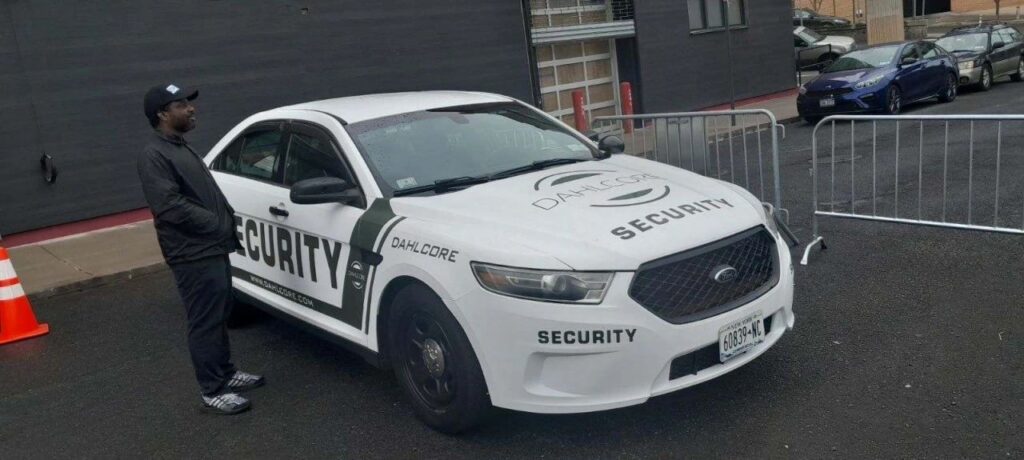
Dahlcore Security Guard Services deploys guards specifically trained for urban mixed-use environments — with protocols built for the kind of layered access challenges Tribeca buildings present.
Legal and Ethical Considerations for Tribeca Property Owners
Security in New York City doesn’t exist in a legal vacuum. Property owners have obligations, and security decisions need to be made with those in mind.
New York State building codes and fire egress requirements govern how access control can be implemented. Emergency exits must remain operable from the inside at all times, regardless of the access system layered on top. This is a point of tension in some older loft conversions where fire doors are also used as routine access points.
Tenant privacy rights are relevant when deploying surveillance systems. In New York, you generally cannot install cameras in areas where tenants have a reasonable expectation of privacy — bathrooms, changing areas, or inside individual units. Common areas, lobbies, and building exteriors are appropriate. Make sure your camera placement is documented and disclosed to tenants in accordance with your lease agreements.
Security guard licensing. In New York State, security guards must be registered with the Department of State under the Security Guard Act. Companies deploying guards must also be licensed. When hiring a security firm, verify their licensing status. Dahlcore Security Guard Services operates in full compliance with New York State security regulations.
Data retention and storage. Storing surveillance footage carries data responsibilities. Understand your obligations if footage is ever requested by law enforcement or used in a legal proceeding.
Working with a security firm that understands New York City’s specific regulatory environment reduces liability exposure significantly.
Maintenance of Security Measures
Installing a security system is not a one-time event. Without regular maintenance, even a well-designed system degrades.
What regular maintenance looks like:
- Camera checks: Verify that all cameras are operational, lenses are clean, and fields of view haven’t been obstructed by new signage or vegetation
- Access credential audits: Conduct a review of active key fobs, mobile credentials, and access codes at least quarterly — and immediately following any tenant turnover or staff change
- Alarm testing: Test intrusion detection systems on a scheduled basis
- Software and firmware updates: Access control and surveillance platforms push security patches that need to be applied
- Incident log review: Even in quiet periods, reviewing access logs and any minor incidents helps identify patterns before they become problems
How often should systems be updated? Hardware typically has a useful life of five to seven years before resolution, storage, and integration capabilities fall behind current standards. Software and firmware should be updated as patches are released. Access control lists should be reviewed at a minimum of quarterly.
Case Studies: Security Strategies That Work in Practice
While specific client details are kept confidential, the following scenarios reflect common challenges and solutions in Tribeca’s mixed-use building environment.
Scenario 1: The propped fire door problem. A six-story loft building near the Hudson waterfront discovered through a security audit that a ground-floor fire exit adjacent to the loading area was being propped open by commercial tenants during business hours for convenience. The solution wasn’t disciplinary — it was operational. An electromagnetic hold-open device was installed that kept the door open legitimately during business hours but integrated with the fire alarm system to release and lock automatically after hours and during emergencies.
Scenario 2: Package theft in an unmonitored lobby. A mixed-use building with a high-traffic residential population was experiencing consistent package theft from an unmonitored lobby area. Installing a dedicated package room with key fob access — and repositioning an existing camera to provide coverage — eliminated the problem without requiring additional staffing.
Scenario 3: Commercial tenant after-hours access. A restaurant operating until 2 AM on a building’s ground floor created a persistent challenge: staff entering and exiting via a shared corridor that connected to residential elevator banks. The solution was a time-restricted access credential system that limited where and when restaurant staff credentials were valid, combined with a patrol check at closing time.
These aren’t unusual problems. They’re the kinds of friction points that come up in almost every mixed-use building — and they all have practical, proportionate solutions.
Conclusion: Building Security Is a System, Not a Purchase
The properties that maintain strong security in Tribeca aren’t the ones with the most expensive systems. They’re the ones where technology, personnel, policy, and maintenance work together as a coordinated system — and where property owners treat security as an ongoing priority rather than a one-time capital expenditure.
Tribeca’s character makes it worth protecting well. The right security strategy doesn’t undermine the feel of the neighborhood or make residents feel surveilled. It makes the building function better, reduces liability, and gives tenants the confidence to call the building home long-term.
If you’re not sure where your property stands today, a professional security consultation is the right first step.
Ready to assess where your building stands? Contact Dahlcore Security Guard Services for a personalized property security consultation tailored to Tribeca’s mixed-use building environment.
Key Takeaways
- Tribeca’s mixed-use, loft-heavy building stock creates layered security challenges that generic solutions don’t address well.
- A security audit is the necessary first step before investing in any system or service.
- Access control is the highest-leverage investment for most mixed-use buildings — separating commercial and residential zones prevents the majority of unauthorized access issues.
- Security personnel should be trained to work alongside technology, not independently of it.
- Legal compliance — including guard licensing, tenant privacy, and fire egress requirements — is non-negotiable in New York City.
- Security systems require ongoing maintenance and regular credential audits to stay effective.
- The goal is a system where technology, personnel, and property management protocols reinforce each other.
FAQs
What are Tribeca’s biggest security challenges for property owners?
The primary challenges are managing multiple access points across mixed commercial and residential uses, controlling visitor and vendor traffic across different tenant types, and retrofitting security systems into buildings originally designed for industrial use rather than secure residential occupancy.
How often should security systems be updated?
Access control credential lists should be audited at least quarterly and after every tenant change. Software and firmware should be updated as patches are released. Physical hardware typically needs evaluation every five to seven years, though specific timelines depend on the system and usage.
What security technologies are most effective for mixed-use buildings?
A layered approach works best: IP surveillance cameras with cloud storage, an access control system that separates residential and commercial zones, a visitor management intercom at the main entrance, and intrusion detection for commercial spaces during after-hours periods. Integration between these systems — so that an alert in one platform triggers action in another — significantly increases effectiveness.
What role do security personnel play in property management?
Guards in mixed-use buildings serve as the human layer of the security system — monitoring technology feeds, enforcing access protocols, conducting patrols, and serving as the first point of contact for incidents or tenant concerns. They also provide a visible deterrent that no camera alone can replicate.
How can I conduct an effective security audit?
Walk the property at multiple times of day, including evenings. Document all access points, lighting conditions, camera coverage, and any areas where access protocols aren’t being followed. Review your incident history for patterns. Then compare what you find against a structured checklist. For a thorough assessment, engaging a professional security firm to conduct the audit provides an objective outside perspective.
Do security guards in New York City need to be licensed?
Yes. Under the New York State Security Guard Act, individual security guards must be registered with the Department of State, and the companies employing them must hold a license. Always verify licensing when hiring a security firm.
Can I install cameras anywhere in my building?
Not without restriction. Cameras are appropriate in common areas, lobbies, building exteriors, and commercial tenant spaces. They cannot be placed in areas where tenants have a reasonable expectation of privacy. Placement should be disclosed to tenants per lease terms, and footage retention should be managed responsibly.
What’s the most common security mistake mixed-use property owners make?
Treating commercial and residential access as a single zone. When everyone — residents, commercial tenants, their staff, vendors, and visitors — can access the same areas without differentiation, it becomes impossible to enforce meaningful access control. Zone separation is the foundational principle that most other security improvements build on.
