

When an emergency happens at a school, there is no time to figure things out on the fly. Every second matters. In a city as dense and complex as New York, where public schools serve over one million students across five boroughs, the stakes are even higher. A well-built emergency response plan is not just a legal checkbox — it is the difference between chaos and a coordinated, life-saving response.
This guide walks school administrators, principals, safety directors, and campus facility managers through exactly how to develop an emergency response plan for educational institutions in NYC. From risk assessment to staff training to integrating professional security services, this is a practical, step-by-step resource you can act on today.
Understanding the Essentials of an Emergency Response Plan
An emergency response plan (ERP) is a documented, actionable framework that tells everyone in a school — from the principal to the custodian — what to do when something goes wrong. It covers who does what, how information flows, and how the school works with outside agencies like the NYPD, FDNY, and NYC Emergency Management.
A solid school emergency response plan includes:
- Hazard identification: What specific threats could affect your campus?
- Roles and responsibilities: Who leads the response? Who handles communications?
- Response procedures: Step-by-step actions for different emergency types
- Communication protocols: How do you notify staff, students, families, and first responders?
- Recovery steps: What happens after the immediate crisis is over?
The NYC Department of Education (NYC DOE) requires each school to maintain a current School Safety Plan, which includes emergency response components. But compliance is a floor, not a ceiling. The best plans go further — they are living documents that reflect the real layout, population, and risk profile of your specific building.
Assessing Risks and Vulnerabilities
Before you can plan for emergencies, you need to know what you are actually planning for. A risk assessment is your starting point.
Identify Threats Relevant to NYC Schools
New York City schools face a range of threats that may not apply in other parts of the country. Your assessment should account for:
- Natural hazards: Coastal flooding, winter storms, and extreme heat are real concerns, especially for schools in low-lying areas of Brooklyn, Queens, and Staten Island. Hurricane Sandy demonstrated how quickly NYC infrastructure can be overwhelmed.
- Human-caused threats: Intruder events, civil unrest, suspicious packages, and bomb threats require specific protocols.
- Infrastructure issues: Aging buildings, gas leaks, power outages, and elevator failures are common in older NYC school facilities.
- Public health emergencies: The COVID-19 pandemic highlighted how unprepared many institutions were for large-scale health crises.
Conduct a Physical Walkthrough
Walk every part of your campus with fresh eyes. Ask:
- Where are the blind spots in camera coverage?
- Which entry points are unsecured or poorly monitored?
- Are evacuation routes clearly marked and free of obstruction?
- Where do large groups congregate, and how quickly can they be moved?
Involve Multiple Perspectives
Your risk assessment should not be done in isolation. Pull in your school safety agent, facilities manager, a teacher representative, and ideally a professional security consultant. Different people notice different vulnerabilities. Document everything you find. This becomes the foundation of every protocol you write.

Establishing a Response Team
An emergency response plan is only as strong as the people behind it. Schools need a designated Emergency Response Team (ERT) — a small group of trained individuals who know the plan cold and can execute under pressure.
- Incident Commander: Usually the principal; oversees all emergency decisions
- Safety Coordinator: Manages evacuation, shelter-in-place, and lockdown procedures
- Communications Lead: Handles notifications to staff, families, and external agencies
- Medical First Responder: School nurse or trained staff member; addresses injuries
- Facilities Lead: Manages utilities shutoff, building access, and staging areas
Build in Redundancy
Every role needs a backup. If the principal is off-site when an incident occurs, the assistant principal needs to be ready to take command without hesitation. The same applies down the line. In NYC schools, where substitute teachers and rotating staff are common, documented role assignments matter more than informal understandings.
Connect with External Partners
Your ERT should have pre-established relationships with your local NYPD precinct, school safety division, and NYC Emergency Management. These connections should be made before an emergency — not during one.
Developing Procedures and Protocols
This is the operational core of your emergency response plan. Procedures tell people exactly what to do in specific scenarios. Vague guidance fails under stress. Specific steps succeed.
Lockdown Procedures
A lockdown is initiated when there is an immediate threat inside or near the building.
Steps:
- Announcement made over the intercom or via the alert system.
- All exterior doors secured immediately.
- Students and staff move to designated interior rooms away from windows and doors.
- Lights off, doors locked, silence maintained
- No one enters or exits until cleared by law enforcement.
- Communications Lead notifies NYPD and NYC DOE Office of Safety.
Fire Evacuation
Despite being the most-drilled scenario, fire evacuations still fail when routes are blocked or when students panic.
Steps:
- Fire alarm activates, or a staff member initiates a manual alarm.
- Designated exit routes are used based on classroom location
- Teachers take attendance rosters and account for every student at the assembly point.
- Facilities Lead confirms building is clear and utilities are shut off if safe to do so
- No re-entry until FDNY provides all-clear
Shelter-in-Place
Used during hazardous material events, severe weather, or external threats.
Steps:
- Announcement issued to move to the designated interior rooms.
- HVAC systems shut off to prevent outside air from entering
- Doors and windows are sealed if there is a chemical or air quality threat.
- Students remain calm and seated; teachers maintain control.
- Communications Lead monitors updates from NYC Emergency Management.
Natural Disaster Response
For earthquakes (rare but possible), flooding, or severe storms:
- Pre-identified safe zones based on building structural assessments
- Evacuation routes that account for flooding on ground floors
- Communication with NYC Emergency Management for shelter-in-place vs. full evacuation decisions
Build a Quick-Reference Card. For each scenario, create a one-page laminated quick-reference card that lives in every classroom. It should list the first five steps of each procedure. Teachers should not have to remember — they should be able to glance and act.
Integrating Security Services
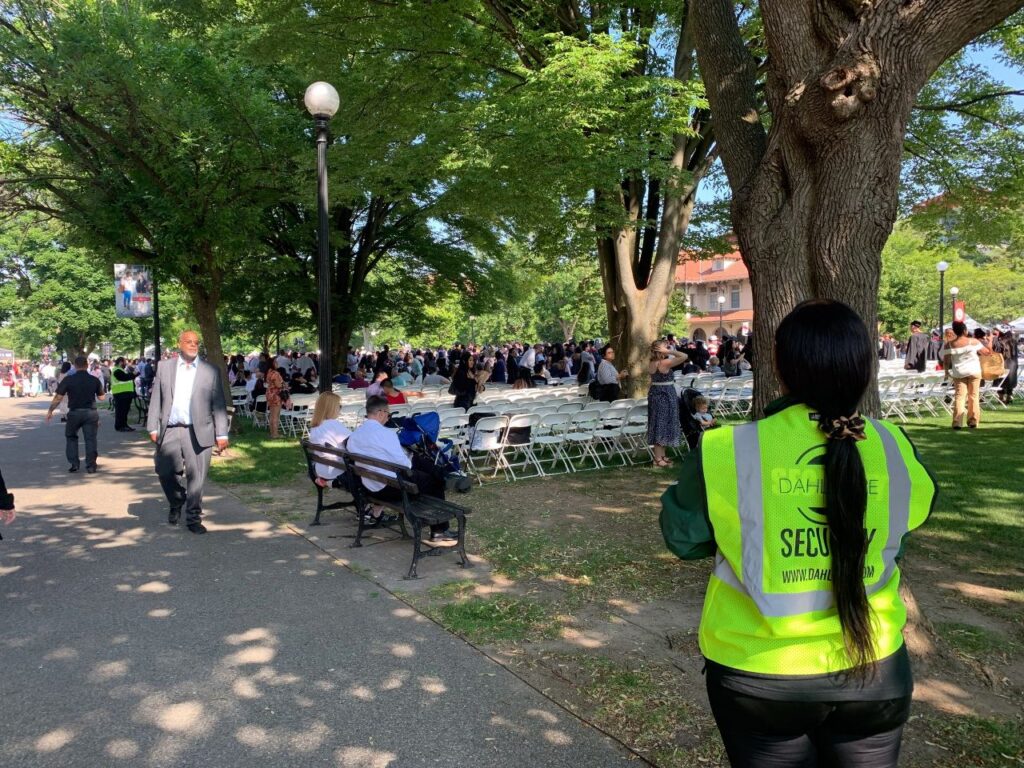
Professional security services play a concrete role in making an emergency response plan work on the ground. While school safety agents and administrators manage the institutional side, private security providers like Dahlcore Security Guard Services add a trained, dedicated layer of protection that strengthens your overall preparedness.
What Professional Security Adds
Controlled access management: During an emergency, controlling who enters and exits the building is critical. Trained security personnel can manage entry points, screen individuals, and prevent unauthorized access — tasks that are difficult to ask of administrative staff in a crisis.
Real-time threat monitoring: Security professionals trained in situational awareness can identify concerning behavior before it escalates. This proactive posture can stop incidents at the pre-threat stage.
Support during drills and real events: Having professional security present during emergency drills makes them more realistic. During an actual event, they serve as an organized force that supports the school’s ERT and coordinates with first responders.
Documentation and incident reporting: A professional security team maintains detailed logs that can be critical for post-incident reviews, insurance purposes, and legal compliance.
Coordination is Key
Integrating a security service into your plan requires clear communication of roles. Security personnel should understand the ERT structure, know the building layout, and be part of at least one tabletop exercise per year. Their role supplements — but does not replace — the school’s internal safety protocols.
Dahlcore Security Guard Services works directly with school leadership to align security operations with institutional emergency plans, ensuring every layer of response is coordinated and ready.
Training and Drills
A plan that lives only on paper is not a plan — it is a document. Regular training and drills are what turn written procedures into muscle memory.
Mandated Requirements in NYC
NYC schools are required to conduct specific drills throughout the year, including fire drills and lockdown drills, in accordance with NYC DOE guidance and New York State Education Law. But frequency requirements are a minimum. Schools with more complex risk profiles should do more.
Types of Training to Implement
- Tabletop exercises: Scenario-based discussions where the ERT walks through their response to a hypothetical event. Low cost, high value for identifying gaps.
- Full-scale drills: Simulated emergencies involving all staff and students. These reveal how well procedures hold up under realistic conditions.
- Role-specific training: First aid and CPR for designated staff, de-escalation training for teachers, and crisis communications training for the Communications Lead.
Making Drills Productive, Not Performative
After every drill, conduct a debrief. What worked? What confused? Were there students who did not follow instructions? Were there physical bottlenecks in the evacuation route? Document findings and update procedures accordingly. A drill that reveals a flaw is a success — that flaw would have been far more costly in a real event.
Communication Strategies During Emergencies
Clear, fast communication during a crisis prevents secondary harm. When people do not know what is happening, they make dangerous assumptions.
Layers of Communication
Internal (staff and students):
- Intercom announcements for building-wide alerts
- Code words or plain-language announcements based on threat type
- Teacher communication via school app or two-way radios
External (families and community):
- Pre-configured mass notification system (NYC DOE uses tools like School Messenger)
- Social media monitoring to address misinformation quickly
- Designated spokesperson for media inquiries — typically the principal or a district representative
With first responders:
- Designated meeting point for incoming NYPD or FDNY units
- Pre-shared building maps stored with the local precinct
- Clear chain of command so first responders know exactly who to talk to on arrival
One critical rule: do not let unofficial communications — group texts, social media posts by staff — outpace official notifications. Families who receive conflicting information panic. Train your team on communication discipline before it is needed.
Reviewing and Updating the Plan
An emergency response plan written three years ago may already be outdated. Buildings change. Enrollment shifts. New threats emerge. Staff turns over. The plan has to keep pace.
When to Review
- Annually, at a minimum: Schedule a formal review at the start of each school year before students arrive
- After any incident or drill debrief: If something revealed a gap, update the plan before the next school year.
- After significant building or staff changes: New construction, renovations, a new principal, or changes in student population all affect the plan’s accuracy.
- When regulations change: Stay current with NYC DOE policy updates and New York State guidance.
What to Review
Go through every section systematically:
- Are contact lists for ERT members and external agencies current?
- Do evacuation maps reflect the current building layout?
- Have any new hazards been identified in the risk environment?
- Are new staff members trained on their roles?
Document Version Control
Every time the plan is updated, note the revision date on the cover page and distribute updated copies to all ERT members. Outdated plans in circulation are dangerous — they create confusion when it matters most.

Key Takeaways
- An emergency response plan is a living document that requires consistent attention, not a one-time project.
- NYC schools face a distinct mix of threats — natural, human-caused, and infrastructural — that must be addressed in a locally-tailored risk assessment.
- Your Emergency Response Team needs clearly defined roles, trained backups, and pre-built relationships with external agencies.
- Procedures should be scenario-specific, step-by-step, and accessible during a crisis — laminated quick-reference cards in every classroom are a simple, effective tool.
- Professional security services like Dahlcore complement internal safety teams and add a critical layer of trained, on-the-ground response capability.
- Drills only add value when followed by honest debriefs and documented improvements.
- Communication discipline — internal and external — prevents secondary harm during any emergency.
- Review and update the plan at a minimum annually, and after any incident or significant change.
Resources and Templates
Building your emergency response plan from scratch is challenging. Fortunately, there are strong resources available specifically for NYC schools and educational institutions:
- NYC Department of Education Office of School Safety: Provides the framework for required School Safety Plans and guidance on compliance.
- NYC Emergency Management (NYCEM): Offers hazard-specific planning resources and community preparedness tools relevant to NYC’s unique risk landscape.
- Federal Emergency Management Agency (FEMA) – K-12 School Security Guide: A comprehensive national framework adaptable to local needs.
- CISA (Cybersecurity and Infrastructure Security Agency) – K-12 School Security Guide: Includes physical security checklists and emergency planning templates.
- New York State Education Department (NYSED): Publishes guidance on Project SAVE (Safe Schools Against Violence in Education) compliance requirements.
For a ready-to-use starting point, Dahlcore Security Guard Services offers consultation services to help school administrators build or audit their current emergency response plan. Reach out to our team to discuss your specific campus needs.
FAQs
What are the essential components of a school emergency response plan?
A complete school emergency response plan includes a risk assessment, defined roles and responsibilities, scenario-specific procedures (fire, lockdown, shelter-in-place, natural disaster), communication protocols, staff training requirements, and a schedule for review and updates. It should also include current contact lists for internal staff and external agencies like the NYPD and FDNY.
How can schools in NYC address specific local threats?
NYC schools should factor in the city’s unique risk profile: coastal flooding, severe winter weather, aging infrastructure, high population density, and urban-specific human threats. Connecting with your local NYPD precinct and NYC Emergency Management early in the planning process helps ensure your plan reflects current, localized threat intelligence.
How often should emergency drills be conducted in schools?
NYC schools are legally required to conduct fire drills and lockdown drills at intervals specified by the NYC DOE and New York State law. Beyond compliance, best practice is to conduct at least one tabletop exercise per semester with the ERT and a full-scale drill annually. Every drill should be followed by a documented debrief.
What is the role of a security service in school emergency preparedness?
Professional security services provide trained personnel who manage access control, monitor for pre-incident behavior, support staff during drills, and coordinate with first responders during actual emergencies. They add a layer of dedicated, trained capacity that administrative staff cannot always provide — especially during high-stress situations.
How can schools effectively communicate during a crisis?
Use a layered communication approach: intercom for internal alerts, mass notification systems for families, pre-shared building maps, a clear point-of-contact for first responders, and designated spokespeople for media. Train staff on communication discipline to prevent conflicting unofficial messages from spreading.
What is an emergency response plan for schools?
It is a written, actionable document that defines how a school responds to emergencies — who does what, in what order, and how communication flows internally and externally. It covers multiple threat types and is tailored to the specific building, population, and risk environment of each campus.
Why are emergency plans important for schools?
Schools are responsible for the safety of a large, vulnerable population — children. A well-developed emergency plan reduces response time, prevents secondary harm, ensures legal compliance, and gives staff the confidence to act decisively when it matters most. In a city like NYC, where emergencies can escalate quickly in dense environments, preparation is not optional.
How often should school emergency plans be updated?
At minimum, annually — ideally at the start of each school year. Plans should also be updated after any incident, significant building or staff change, drill debrief that reveals gaps, or when local regulations are updated.
