

Last updated: December 23, 2025
Security Patrol Officer Duties: Checklist, Reporting, Access Control & Emergency Response
Security patrol officer duties include patrolling and inspecting assigned areas, deterring suspicious activity, controlling access, responding to alarms and emergencies, and documenting everything in patrol logs and incident reports. These duties may be performed on foot (site/roving patrol) or in a vehicle (mobile patrol), depending on your post orders, site risks, and client requirements. Use the checklist and SOP-style workflow below to write post orders, train officers, and standardize reporting.
Key takeaways:
- Patrol and inspect (perimeter, doors, lighting, hazards) on a defined route—then randomize it.
- Control access (IDs, visitor/vendor/vehicle logs) and prevent tailgating.
- Respond to alarms/emergencies using post orders (SOP) and document actions in a Daily Activity Report + Incident Report.
At-a-Glance Duties Checklist
Use this as a “post orders” starter checklist for a security patrol guard (mobile/roving/site patrol).
- Complete perimeter checks (gates, fences, vulnerable exterior points).
- Inspect doors/windows for forced-entry signs and confirm locks are secure.
- Verify lighting is operational in parking lots, stairwells, and entrances.
- Identify safety hazards (spills, trip hazards, blocked exits) and report/mitigate per SOP.
- Maintain a visible presence to observe & deter loitering, trespassing, and vandalism.
- Watch for suspicious activity patterns (casing, tampering, tailgating, forced access attempts).
- Monitor CCTV/alarm panels if assigned, and investigate activations promptly.
- Perform access control: verify credentials, enforce sign-in/out, issue badges if required.
- Maintain visitor/contractor/delivery and vehicle logs (time, destination, escort rules).
- De-escalate when safe and authorized; call law enforcement/EMS per escalation path.
- Secure scenes (preserve evidence, restrict access, protect witnesses) when incidents occur.
- Provide basic assistance (directions/customer service) while maintaining security posture.
- Write a Daily Activity Report (DAR) each shift and complete Incident Reports for events.
- Notify the client/contact list using the proper chain of command (dispatch → supervisor → client).
- Handover to the next officer with pass-down notes (issues, hazards, watch items).
Duties by Category (Duty Framework)
Patrol & Inspection (Site Patrol / Perimeter Checks)
Patrol officers perform scheduled and/or randomized property inspections to detect hazards, damage, or signs of intrusion, and they document findings for the client or supervisor.
Practical patrol inspection points to standardize in your patrol checklist:
- Perimeter: fences, gates, access roads, parking lots.
- Building exterior: doors, windows, roof hatches (if applicable), loading docks.
- High-risk areas: storage rooms, generator rooms, construction materials, cash-handling zones.
- Life-safety: fire lanes clear, emergency exits unobstructed, obvious hazards flagged.
Observe & Deter (Roving Patrol Visibility)
A major part of patrol work is deterrence—being seen, scanning for anomalies, and addressing suspicious behavior early through presence and reporting.
Include these “observe & deter” SOP cues in post orders:
- Repeatable scan pattern (left-to-right, near-to-far) during every round.
- “Normal vs abnormal” notes (what should be open/closed, lit/unlit, occupied/unoccupied).
- Trespassing/loitering handling script (verbal warning → notify → escalate).
Access Control & Logs (People/Vehicles)
Access control commonly includes checking IDs/credentials, managing entry points, preventing tailgating, and maintaining visitor activity logs.
Operational basics to include:
- Visitor/vendor intake: name, company, person visited, time in/out, badge number, and escort rule.
- Vehicle log: plate, driver, purpose, bay/lot, time in/out, exceptions.
- Exception handling (after-hours, “forgot badge,” emergency maintenance) with documented approvals.
Incident Response (Alarms, Emergencies, Escalation)
Patrol officers are expected to respond quickly to alarms/emergencies and coordinate escalation to supervisors or emergency services based on site policy.
Standard incident response actions to define in SOP:
- Verify the alarm source (zone/location), approach safely, and request backup if needed.
- Preserve life safety first (medical/fire), then property, then evidence.
- Document time stamps (dispatched, arrived, actions taken, who notified, resolution).
Documentation (DAR + Incident Report)
Documentation is repeatedly emphasized as a core duty because it creates an auditable record of observations and actions taken.
Most incident report guidance stresses objective facts (who/what/when/where/how), clear time stamps, and recording actions taken/notifications made.
Shift Workflow (SOP-Style Steps)
1. Start of shift (5–15 minutes)
- Receive post orders/pass-down; confirm site contact list and escalation rules.
- Inspect equipment (radio/phone, keys, flashlight, PPE, body cam if used).
- Confirm critical zones (restricted areas, current hazards, recent incidents).
2. During patrol rounds
- Run the patrol checklist (perimeter → entrances → high-risk zones → life-safety checks).
- Randomize timing and route when policy allows (avoid predictable patterns).
- Log observations in real time (digital reporting app or notebook).
3. Incident handling
- Make the scene safe, request assistance, and follow the escalation policy.
- Separate “what was observed” from “what was reported” (witness statements).
- Capture evidence references (CCTV camera numbers, photos, alarm zone IDs).
4. End of shift
- Complete the DAR, attach incident reports, and submit before leaving the site.
- Provide pass-down notes: unresolved issues, hazards, watch list items, and equipment status.
Foot Patrol vs Vehicle Patrol Duties
Foot patrol and vehicle patrol share the same core objectives (detect, deter, respond, document), but the execution differs.
Foot Patrol Duties (Site Patrol)
- Closer inspection: doors, locks, stairwells, interior corridors, tenant spaces (as authorized).
- More interaction: visitor questions, employee/customer service, de-escalation presence.
- Better hazard spotting: spills, trip hazards, blocked exits, suspicious packages.
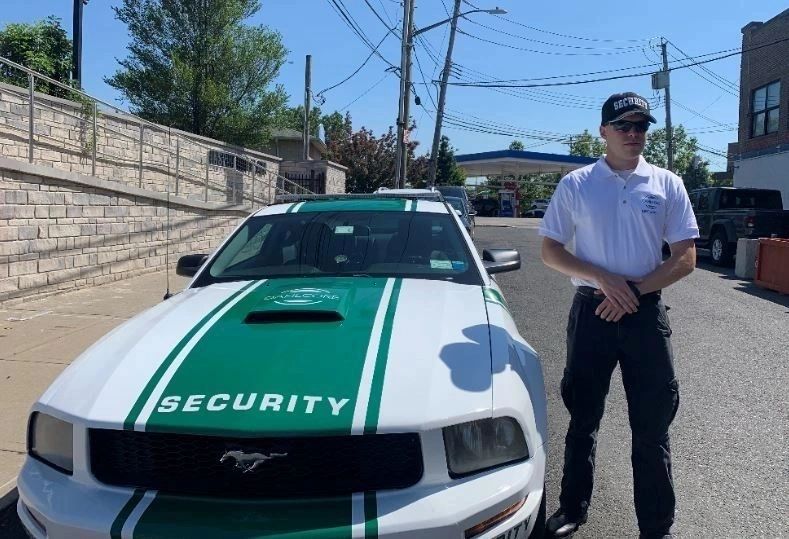
Vehicle Patrol Duties (Mobile Patrol Officer)
- Wider coverage: multiple properties or large sites (industrial parks, campuses, subdivisions).
- Faster alarm response: quicker arrival to alarms, gates, and perimeter breaches.
- Exterior-first priority: perimeter checks, parking lots, access roads, gate integrity, lighting sweeps.

Templates (E‑E‑A‑T proof)
Daily Activity Report (DAR) Outline (redacted-style)
- Site / Post:
- Officer name / ID:
- Shift date/time:
- Patrol rounds completed (times):
- Observations (time-stamped bullets):
- Hazards found + actions taken:
- Access control notes (visitors/vendors/vehicles):
- Alarms/dispatch calls handled:
- Maintenance issues reported:
- Pass-down notes for next shift:
Incident Report Template (Fill-in)
- Date/Time reported:
- Incident time range:
- Exact location:
- Type: (trespassing / vandalism / theft / medical / fire / alarm / safety hazard)
- People involved: (names, descriptions, contact info if authorized)
- Narrative (objective): Who/What/When/Where/How
- Actions taken: (verbal warning, first aid, secured area, escorted, detained if authorized)
- Notifications: (supervisor, client, police/EMS/fire; report/case numbers)
- Evidence: (CCTV camera IDs, photos, logs, witness statements)
- Outcome/Status: (resolved, pending investigation, follow-up needed)
For report-writing fundamentals and what to include, use a formal training reference such as a “report writing” module from a security training provider.
Common scenarios (mini-SOPs)
Alarm Response & Escalation Path
- Verify alarm zone/location → approach safely → request backup if policy requires.
- If intrusion suspected: do not enter alone; stage and call law enforcement per SOP.
- Document time stamps (dispatch/arrival/clear) and who was notified.
Suspicious Person / Trespassing
- Maintain distance and visibility; use calm verbal commands.
- If non-compliant: disengage to safety and escalate (dispatch/supervisor/law enforcement).
- Record description, direction of travel, and any vehicle plate.
Access Control Exceptions (Contractors/Deliveries)
- Validate work order or client approval.
- Log identity + time + destination; apply escort/badge rules.
- If approval cannot be verified, deny entry per post orders and document.
What Changes By Site Type?
- Construction: focus on perimeter breaches, material theft, after-hours access control, and hazard reporting.
- Hospitals: tighter visitor controls, restricted zones, patient/staff safety coordination; visitor management is often treated as a core access control function.
- Hotels: guest privacy + access control + disturbance response + management documentation.
- Retail: visible deterrence, shoplifting observation/reporting, incident documentation, customer service.
FAQs
What does a security patrol officer do during a shift?
A patrol officer follows post orders and a patrol checklist to inspect the property, deter suspicious activity, control access where assigned, respond to alarms/emergencies, and document everything in daily logs and incident reports. The job is “operational” rather than theoretical: the duty is to notice problems early, act within policy, and escalate correctly when safety or crime risks appear.
How often should patrols be randomized?
Patrol timing and routes should be randomized when the contract and site safety allow, because predictable patrol patterns are easier to exploit. A practical policy is to keep required checkpoints consistent (life-safety, gates) but vary the order and exact timing to reduce predictability.
What should be included in a patrol report or incident report?
Include objective facts, time stamps, exact location, involved parties (when authorized), actions taken, and who was notified. Also, reference supporting evidence such as CCTV camera IDs, photos, and any case/report numbers provided by responding authorities.
Do patrol officers do access control?
Yes—many patrol roles include credential checks, visitor/vendor processing, and logging entries/exits, especially on sites where patrol officers also cover gates or reception during rounds. Even when not stationed at an entrance, patrol officers often identify tailgating or unauthorized access attempts and escalate per policy.
What’s the difference between a security officer and a patrol officer?
A security officer has a broad role that can include fixed-post (on-site) duties like monitoring entrances or CCTV, while a patrol officer is specifically assigned to roving patrol rounds across a site or multiple sites. Both roles commonly share core responsibilities like observation/reporting, access control, and incident response, but patrol officers emphasize inspections and mobility.
Check other blogs:
Hospital Emergency Response: Key Strategies & Insights
Difference Between Protesters and Rioters
Case Studies: Successful Security Interventions in Hospitals
