

Last Updated: January 20, 2026
Disclaimer: This article is for general information, not legal advice. Laws, licensing rules, and powers (including detention and use-of-force limits) vary by country, state/province, and local policy.
Direct answer: A security guard typically works in private security to protect a specific property or client site by patrolling, monitoring, controlling access, and reporting incidents. A police officer is a sworn government law-enforcement professional with broader authority to enforce laws and respond across a public jurisdiction. Exact powers vary by jurisdiction and agency policy.
Definition
What is a security guard?
A security guard is a private security professional hired to help protect people, property, and operations on a specific site (such as a business, residential community, or event).
Security guards commonly provide visible deterrence, patrol assigned areas, monitor alarms/cameras, and document issues through incident reporting.
Security guard licensing requirements depend on location, and requirements may differ for armed vs unarmed roles.
What is a police officer?
A police officer is a sworn law-enforcement professional employed by government agencies to protect lives and property and maintain public safety within a defined jurisdiction.
Police roles can include enforcing laws, responding to emergencies, and gathering facts/collecting evidence for possible crimes (often handled by detectives/investigators).
Police typically must complete their agency’s academy training before on-the-job training.
Side-by-Side Differences
Key Differences
- Authority & Legal powers: Police have government-granted authority; security guards usually operate under private policies and limited legal powers that vary by jurisdiction (avoid assumptions; confirm local rules).
- Jurisdiction: Security guards usually focus on a client site/property; police operate across a broader public jurisdiction.
- Core Duties: Guards focus on patrol, monitoring, access control, de-escalation, and incident reporting; police focus on law enforcement and public-safety response.
- Detain vs Arrest: In many places, security may only detain/arrest under limited “citizen’s arrest” conditions, and the exact rules vary by jurisdiction.
- When to Escalate: Security handles policy violations and non-violent issues when safe; call police for violence, immediate threats, or serious crime-in-progress.

Comparison
Category: Employer
- Security guard: Private company / contracted client
- Police officer: Government agency (city/county/state/federal)
Category: Primary mission
- Security guard: Protect a specific site, deter issues, enforce site rules, and report incidents
- Police officer: Public safety, law enforcement, emergency response, investigations
Category: Jurisdiction
- Security guard: Usually limited to the assigned property/client scope
- Police officer: Broader public jurisdiction (as defined by the agency)
Category: Typical actions
- Security guard: Patrol, monitor alarms/video, access control, de-escalation, incident reporting
- Police officer: Enforce laws, respond to calls, collect evidence (role-dependent)
Category: Training baseline
- Security guard: Varies by role and location; licensing may be required (especially if armed)
- Police officer: Academy training required by the agency before on-the-job training
Category: Reporting chain
- Security guard: Site supervisor/account manager/client contact
- Police officer: Sergeant → command staff → department leadership
Similarities
- Both support safety by identifying risk early, responding to incidents, and coordinating help when needed.
- Both rely on communication, de-escalation, and accurate reporting—especially when incidents may become investigations.
- Both may patrol assigned areas as part of day-to-day safety operations.
How they work together
Security teams often serve as the “eyes and ears” on private property by documenting what happened, preserving details (who/what/when/where), and escalating when a situation exceeds site capability. Police can then take over when law enforcement authority, broader jurisdictional response, or criminal investigation is required.
When to Hire Security vs Call Police
Decision Helper: When Security is Usually Appropriate
- Access control and visitor screening (badges, check-in, restricted areas).
- Routine patrol for deterrence (parking lots, perimeters, lobbies).
- Policy enforcement (no-trespass orders, closed areas, posted rules).
- Loss prevention support (observe, document, report, coordinate).
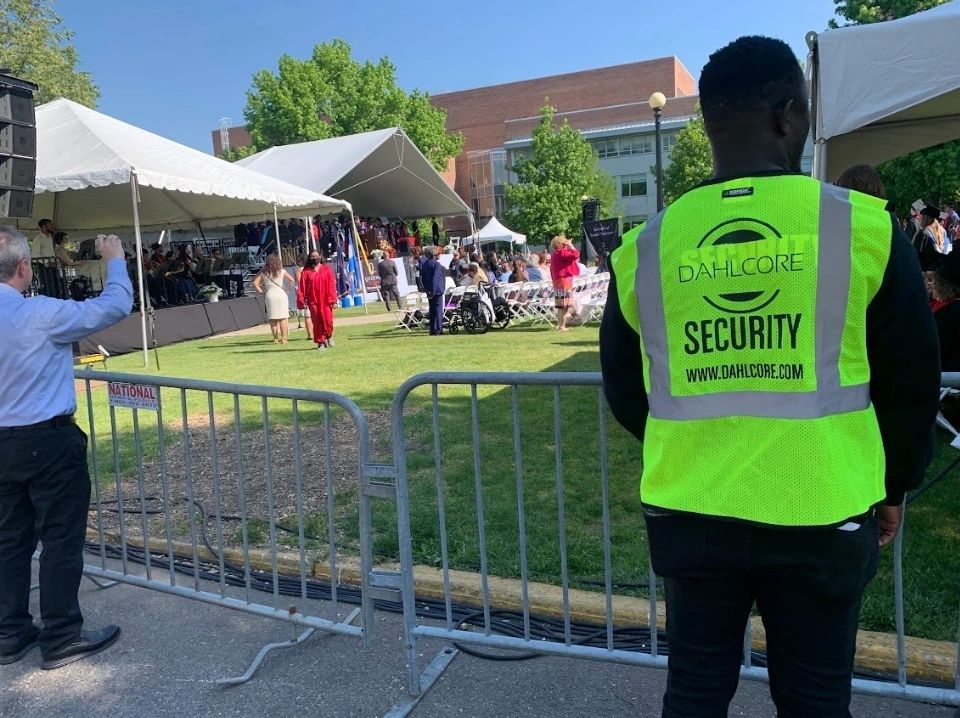
- Event security for crowd management and entry lines.
Decision Helper: When Police Should be Called
- Violence, threats of violence, weapons present, or immediate danger.
- Serious crime in progress (robbery, assault, burglary, stalking).
- Domestic violence situations or credible threats to life safety.
- Medical emergencies requiring EMS (call emergency services first).
- Any incident where safe control cannot be maintained on-site.
Safety-First Escalation Steps (Simple)
- Observe: Note behaviors, descriptions, locations, and time.
- Assess safety: Create distance; do not pursue if unsafe.
- Report: Notify site supervision and start an incident report.
- De-escalate: Use calm verbal direction when appropriate and safe.
- Escalate: Call police/emergency services immediately for violence, weapons, serious crime, or imminent risk.
FAQ (People Also Ask)
Can a security guard arrest you or only detain you?
In many jurisdictions, a security guard’s powers resemble those of a private citizen, and the guard may only detain/arrest under limited circumstances defined by local law. Citizens’ arrest rules vary by state/statute, so confirm local rules for your site.
Do security guards enforce laws or company policy?
Security guards mainly enforce site rules and client policies and document violations through incident reporting. They may observe and report suspected crimes to police rather than acting as law enforcement.
Do security guards carry guns?
Some guards are armed, but requirements vary by location, employer policy, training, and licensing rules. Many places require guards to be licensed by the state—especially if they carry a firearm—so “armed guard” roles usually involve additional compliance steps.
When should you call the police instead of security?
Call police (or emergency services) for violence, threats, weapons, serious crime in progress, or immediate risk to life safety. Use security for prevention, observation, access control, and reporting—then escalate quickly when the situation exceeds site capability.
What’s the difference between jurisdiction and authority?
Jurisdiction describes the geographic or legal area where a role can operate (a property vs an entire city/county). Authority describes the powers a role can legally use (for example, making arrests), which differ between private security and sworn law enforcement.
Do police officers always investigate crimes?
Police work varies by assignment: patrol officers prioritize emergency response and enforcement, while detectives/criminal investigators gather facts and collect evidence for possible crimes. Agency structure and staffing determine who handles which part of an incident.
What should be in a good incident report?
Include who was involved, what happened, when and where it occurred, what actions were taken, and what evidence exists (photos, video timestamps, witness names).
Clear, factual reporting helps supervisors and police understand timelines and make informed decisions.
Can security and police respond to the same incident?
Yes—security may stabilize the scene, separate parties when safe, preserve details, and provide documentation, while police handle enforcement actions and investigation if needed. Coordinated handoff improves speed, clarity, and safety.
Explore our other blog posts here
What is Contract Security and How Does It Work for Businesses?
Top Strategies for Effective Security Asset Protection Overnight
