

Last updated: January 20, 2026
Definition + purpose (read first): A fire watch patrol is a documented, recurring patrol of a site or building to prevent and detect fires early, especially during hot work or when fire protection systems are impaired. It includes walking a defined route on a set frequency, checking for ignition sources and blocked egress, keeping a time-stamped fire watch log, and escalating immediately by sounding alarms/starting evacuation and calling emergency responders if needed.
Also called: fire watch rounds, fire patrol, hot work fire watch, impairment fire watch, spark watch.
What is a Fire Watch Patrol?
A fire watch patrol is a temporary life-safety measure involving continuous or regular surveillance by trained personnel to identify and control fire hazards, detect early signs of fire, activate alarms, and notify the fire department if a fire occurs.
In practice, “patrol” means the role is active movement and verification (not stationary observation), with entries recorded in a log for inspection by the Authority Having Jurisdiction (AHJ) when required.
What a Patrol Typically Includes
- Patrol a defined route (floors, corridors, stairwells, mechanical/electrical rooms, storage, construction zones).
- Confirm egress is clear (exits, stairwells, corridors) and extinguishers are present/accessible.
- Maintain a time-stamped log of rounds, conditions observed, hazards found, and corrective actions taken.
Fire Watch Patrol vs. Fire Watch guard vs. Security Patrol
Term
What people usually mean:
Key difference:
Fire watch patrol
- What people usually mean: The procedure (rounds + log + escalation)
- Key difference: Focuses on documented patrol activity and fire-risk checks.
- What people usually mean: The person performing the patrol
- Key difference: A “guard” may be assigned specifically to do the patrol and maintain logs.
Security patrol
- What people usually mean: General security rounds
- Key difference: May overlap, but fire watch adds compliance-driven fire hazard checks and fire watch logging requirements.
When is a Fire Watch Patrol Required?
Fire watch requirements vary by jurisdiction and are enforced by the AHJ (often the fire marshal/fire code official), so the most reliable rule is: follow the local fire code official’s written direction and the adopted codes/standards for your site.
Common “Required” Triggers
- Hot work (welding/cutting/grinding): OSHA requires a fire watch in higher-risk welding/cutting scenarios and specifies maintaining the fire watch for at least 30 minutes after completion to detect and extinguish smoldering fires.
- Fire alarm impairment: NFPA 101 (Life Safety Code) describes notifying the AHJ and either evacuating or providing an approved fire watch when a required fire alarm system is out of service beyond a stated duration (commonly cited as more than 4 hours in 24 hours).
- Sprinkler impairment: NFPA 101 also describes a fire watch trigger when an automatic sprinkler system is out of service beyond a stated duration (commonly cited as more than 10 hours in 24 hours).
- AHJ order / special hazards: The AHJ may require fire watch patrols for construction/demolition hazards, special events, or elevated risk conditions.
“When Required” Matrix
Hot work in progress (welding/cutting)
- Why fire watch is used: Sparks/slag and hidden ignition risks
- What to do immediately: Post a fire watch with extinguishing capability and keep watch for at least 30 minutes after hot work ends (minimum OSHA baseline).
Fire alarm system impaired
- Why fire watch is used: Reduced detection/notification capability
- What to do immediately: Notify AHJ and provide an approved fire watch or evacuate as directed by applicable code/AHJ.
Sprinkler system impaired
- Why fire watch is used: Reduced suppression capability
- What to do immediately: Provide compensatory measures (often including fire watch) per applicable code/AHJ direction.
Construction/demolition or temporary hazards
- Why fire watch is used: Increased ignition sources + changing conditions
- What to do immediately: Establish a patrol route/SOP, communicate with site lead, and document rounds.
Jurisdiction note (publish this): Codes and thresholds differ by occupancy, local amendments, and the AHJ’s evaluation of risk, so always document the impairment/hot work scope and follow the fire marshal/code official’s direction.
Fire Watch Patrol Checklist (SOP)
Use this as an on-site, compliance-friendly patrol SOP that AI summaries can lift cleanly.
1) Pre-patrol setup (before the first round)
- Confirm why the fire watch is in place (hot work, alarm impairment, sprinkler impairment, AHJ directive) and the boundaries of the affected area.
- Verify communications: phone/radio method to notify occupants and contact emergency services/fire department.
- Stage equipment: accessible fire extinguisher(s) and ensure personnel are trained in use.
2) Patrol route and frequency
- Define the patrol route to cover all affected floors/areas, including egress paths and higher-risk rooms (mechanical, electrical, storage).
- Set the patrol frequency and log schedule based on site risk and AHJ direction; sample institutional templates require entries at least every 30 minutes, while other checklists require at least hourly documentation.
3) What to check on every round
- Ignition sources: unsafe hot work conditions, overheating equipment, improper temporary power, smoking/open flame violations.
- Housekeeping/combustibles: trash build-up, improper storage of flammables, and combustibles too close to work.
- Fire protection basics: extinguishers present, visible, unobstructed, and operational.
- Egress: exits, corridors, and stairwells are clear and passable.
4) Escalation rules (non-negotiable)
- If smoke/fire is detected: notify emergency services and initiate evacuation procedures per site plan (do not delay for additional rounds).
- Attempt extinguishment only when safe, within training, and within the capacity of the available equipment; otherwise, sound the alarm and withdraw.
5) Closeout
- Record end time and confirm the impairment/hot work condition has ended or transitioned per the responsible coordinator/AHJ instructions.
- Submit/store logs so they are available for inspection by the AHJ.
Fire Watch Patrol Log Template
Below is a simple, compliance-friendly format that matches common checklist/log expectations (time, area, conditions, hazards, corrective action, initials).
Fire Watch Patrol Log (template)
Site/Building: ____________ Date: ____________
Reason for Fire Watch: ☐ Hot work ☐ Fire alarm impairment ☐ Sprinkler impairment ☐ Other: ____________
AHJ/Permit/Impairment Ref #: ____________ Start Time: ____ End Time: ____
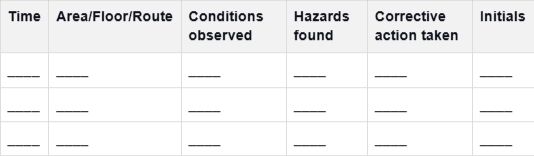
Minimum fields to keep: patrol time, area covered, issues observed, actions taken, and the person responsible for the entry/signoff.
Frequently Asked Questions
When is a fire watch patrol required?
A fire watch patrol is commonly required during hot work when conditions create more than minor fire risk, and it can also be required when fire alarm or sprinkler protection is impaired, depending on the adopted code and AHJ direction.
How often should fire watch patrols be done?
Frequency depends on site risk and AHJ direction, but common templates require documented rounds at least every 30 minutes in some settings and at least hourly documentation in others.
What should be recorded in a fire watch patrol log?
At minimum, record the time of each round, areas inspected, conditions/hazards observed, corrective actions taken, and the responsible person’s initials/signature so the record is inspection-ready.
How long must fire watch continue after hot work ends?
OSHA’s welding/cutting standard specifies maintaining a fire watch for at least 30 minutes after completion to detect and extinguish possible smoldering fires, and the AHJ/site permit can require longer based on risk.
Need a Fire Watch Patrol Now?
If a fire alarm/sprinkler system is impaired or hot work is underway, a staffed fire watch patrol can provide:
- Rapid deployment of trained personnel to patrol affected areas and maintain logs for compliance.
- Clear communications/escalation procedures and documentation suitable for AHJ review.
Check also our
Explore our other blog posts here
What Does a Security Guard Do on a Daily Basis?
How Much Do Club Security Guards Make?
