

Last Updated: January 14, 2026
How can drones improve security? Security drones improve security by providing real-time aerial surveillance, faster incident response, and safer coverage of large or complex sites like commercial properties, construction sites, events, and critical infrastructure. By combining UAV surveillance with AI-powered video analytics, thermal imaging cameras, and autonomous patrol routes, they help security teams detect threats earlier, verify alarms faster, and reduce risk to guards and staff.
How Can Drones Improve Security?
Drones improve physical security by extending real-time situational awareness beyond what fixed cameras and foot patrols can see. Security drones and other unmanned aerial vehicles for security can quickly fly over rooftops, parking lots, perimeter fences, and remote areas to spot intruders, unsafe conditions, or suspicious activity before it escalates.
For properties such as office parks, warehouses, construction sites, stadiums, and other critical infrastructure, drone security systems provide rapid deployment to incidents, high‑angle views, and better context for decision-making. This makes them ideal for modern security programs that need remote monitoring, fast incident response, and more efficient coverage without dramatically increasing staffing costs.
What Are Security Drones?
Security drones are unmanned aerial vehicles for security equipped with HD or 4K cameras, thermal imaging cameras, GPS, and sometimes AI-powered video analytics to monitor sites from the air. These drone security systems stream live video back to a control center, where security operators can direct drone patrols, review incidents, and coordinate with on‑site guards.
Modern UAV surveillance platforms often integrate with existing video management systems, access control, and alarm panels, so drones can launch automatically when sensors trigger. This enables autonomous patrol routes, automatic alarm verification, and remote aerial patrols that fit into an overall perimeter protection strategy.
Key Ways Drones Improve Security
Drones improve security in several core ways that apply across commercial, industrial, and public environments.
- Wide‑area aerial surveillance over large properties, parking lots, and open yards.
- Faster alarm verification and incident response when an intrusion or sensor alert occurs.
- Safer inspection of roofs, remote fences, and hazardous zones without putting guards at risk.
- Night and low‑light monitoring using thermal imaging cameras and low‑light sensors.
- Automated patrol routes that reduce manual patrol workload.
- Evidence capture and incident documentation with recorded video and snapshots.
- Real‑time situational awareness that helps reduce false alarms and focus resources where they matter most.
How Drones Enhance Situational Awareness
Security drones provide enhanced situational awareness and aerial views that static cameras and ground patrols cannot match. By flying above buildings, vehicles, and landscaping, they eliminate many blind spots and give operators a complete view of perimeter lines, access roads, staging areas, and crowd movement.
When paired with AI‑powered video analytics, drone surveillance can automatically detect people or vehicles in restricted zones, track moving targets, and flag unusual behavior. This real-time situational awareness lets security teams quickly differentiate between real threats and routine activity, improving threat detection and false alarm verification.
Enhanced Situational Awareness and Aerial Views
Enhanced situational awareness and aerial coverage are often the first reasons organizations adopt security drones. From an elevated angle, drones can monitor perimeter fences, parking lots, loading docks, and rooftop areas that are hard or expensive to cover with fixed cameras alone.
Examples of where aerial views matter include:
- Perimeter breaches along remote fence lines or back service roads.
- Rooftop inspections of HVAC units, access hatches, and ladders.
- Parking lot monitoring for loitering, theft, and vehicle break‑ins.
- Crowd monitoring at events to identify congestion, unsafe behavior, or emergency access issues.
Faster Incident Response and Patrol Automation
Drones provide faster incident response because they can launch and reach a location in a fraction of the time it takes a guard to walk or drive there. When integrated with sensors or video analytics, drones can automatically fly to alarm locations, stream live video, and help operators assess what is happening in real time.
Autonomous patrol routes allow UAV surveillance systems to fly pre‑planned paths over a property at scheduled times or in response to system triggers. This kind of drone patrol reduces the need for constant manual patrols while maintaining consistent coverage, freeing guards to focus on high‑value tasks and incident handling.
Cost‑Effective Coverage for Large Sites
For large or complex properties—such as industrial facilities, solar farms, logistics hubs, and construction sites—security drones can be more cost‑effective than installing and maintaining extensive camera networks or adding more guards. A single drone can cover multiple acres in minutes, inspect previously unreachable areas, and support remote monitoring from a centralized security operations center.
Because drones provide flexible, on‑demand coverage, organizations can scale monitoring up or down without permanent infrastructure changes. Over time, this can reduce labor costs, minimize the number of cameras required, and lower the cost of responding to false alarms and minor incidents.
Improved Safety for Guards and Staff
Drones improve safety for guards and staff by handling initial inspections in risky or uncertain situations. Instead of sending personnel into a dark lot, onto a roof, or along an isolated fence line, operators can first use drone surveillance to assess conditions from a safe distance.
This approach reduces exposure to potential confrontations, hazardous terrain, and bad weather while still providing detailed information about what is happening on the ground. In critical infrastructure and industrial environments, drones can also inspect equipment and structures, helping safety teams identify issues before they put workers at risk.
Drones for Perimeter and Large‑Area Security
Perimeter protection is one of the strongest use cases for drone security systems. Autonomous perimeter security drones can patrol predefined routes along fence lines, property boundaries, and access roads, maintaining continuous oversight over areas that are difficult to cover with traditional cameras.
When perimeter sensors or analytics detect movement, drones can be dispatched directly to the location to investigate and verify whether a real intrusion is happening. This integration of drones, radar, and PTZ cameras creates a layered defense that combines early detection with rapid, informed incident response.
Drones vs Traditional Security Patrols
Coverage speed
- Traditional patrols: Slower; limited to walking or driving routes.
- Drone‑assisted security: Rapid aerial coverage over large areas and complex layouts.
Access to hazards
- Traditional patrols: Risky for guards in dangerous or remote areas.
- Drone‑assisted security: Remote inspection without exposing personnel to danger.
Night/low‑light detection
- Traditional patrols: Limited by guard line of sight and lighting.
- Drone‑assisted security: Thermal/night vision improves detection in darkness or bad weather.
Operating cost
- Traditional patrols: Labor‑intensive for large sites and multiple patrols.
- Drone‑assisted security: Fewer patrols and cameras needed for the same coverage.
This blended approach does not eliminate security guards but shifts their role toward decision‑making, customer service, and incident resolution while drones handle repetitive patrols and initial assessments.
Industries That Benefit from Security Drones
Security drones deliver value across many types of properties and facilities.
- Construction sites: Monitor materials, verify after‑hours activity, and secure temporary perimeters.
- Industrial facilities and critical infrastructure: Inspect pipelines, substations, yards, and long fence lines.
- Retail centers and parking lots: Watch large lots for theft, vandalism, and unsafe behavior.
- Events and stadiums: Provide crowd monitoring, queue oversight, and emergency access visibility.
- Gated communities and residential complexes: Support virtual guard services and remote monitoring.
These use cases highlight how drones improve physical security while aligning with both operational needs and regulatory constraints.
Dahlcore’s Experience with Drone‑Enabled Security
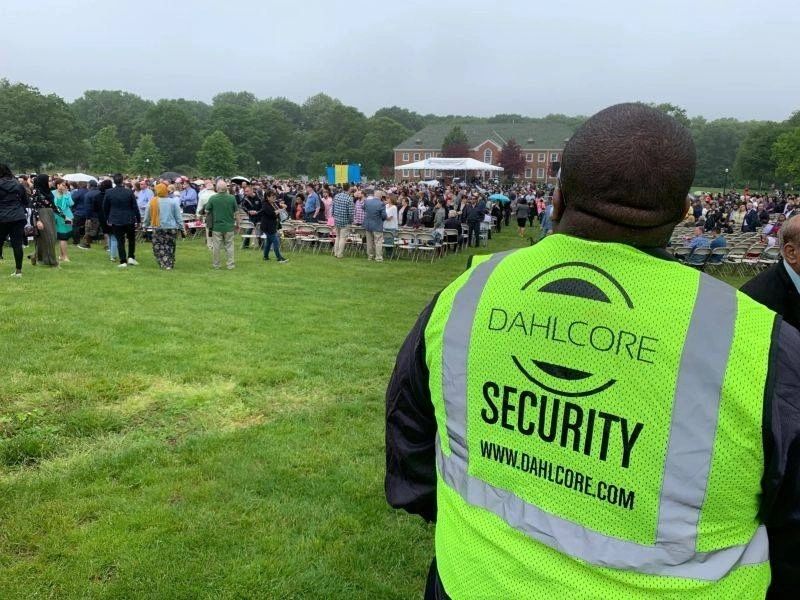
Dahlcore integrates security drones with on‑site guards, cameras, and virtual guard services to provide layered protection for properties that need more than traditional patrols alone. On construction sites, drone patrols help monitor perimeters, equipment yards, and access points, supporting existing construction site security services with faster alarm verification and better visibility.
At events and large commercial properties, Dahlcore can use UAV surveillance to oversee crowds, parking areas, and emergency routes from the air, relaying live video back to a central command center. These drone‑assisted security programs are designed to complement Dahlcore’s guard services, not replace them, so clients get both human judgment and advanced technology on every shift.
Legal and Privacy Considerations
Any deployment of drone security systems must follow aviation regulations (such as FAA Part 107 in the United States) and local airspace rules governing commercial drone operations. Requirements like drone registration, Remote ID, and pilot certification apply when using drones for professional security work.
Privacy is equally important, especially when drones capture video over areas where people may expect confidentiality. Security programs should define clear policies for where drones can fly, how footage is stored, how long data is retained, and how operators avoid unnecessary collection of personal information.
How to Get Started with Drone‑Enhanced Security
Implementing drone‑enhanced security usually follows a few practical steps.
1. Site assessment
- Map critical assets, high‑risk zones, and existing cameras or guards.
- Identify where aerial coverage and autonomous patrol routes will add the most value.
2. Compliance and risk review
- Confirm aviation licensing, Remote ID, and insurance requirements.
- Address privacy, data protection, and local operating rules for security drones.
3. Pilot program
- Launch a limited deployment for specific tasks such as perimeter patrol or parking lot monitoring.
- Test AI‑powered video analytics, incident workflows, and drone patrol schedules.
4. Integration with guards and cameras
- Connect UAV surveillance feeds into the video management system and command center.
- Define how guards request drone support and respond to drone‑verified incidents.
5. Optimization and scaling
- Analyze incident data, response times, and false alarm rates.
- Expand to additional routes, facilities, or services like virtual guard monitoring as results improve.
Dahlcore can help design and manage this entire process so property managers get a tailored drone security plan rather than a one‑size‑fits‑all solution.
FAQs About Drones and Security
Are drones effective for perimeter security?
Yes, security drones are highly effective for perimeter protection because they can quickly patrol long fence lines, property edges, and remote access roads. Autonomous patrol routes and AI‑assisted detection allow drones to identify intrusions, verify alarms, and stream live video from hard‑to‑reach areas in seconds.
How do drones improve response times for security teams?
Drones improve response times by launching immediately when an alarm, sensor, or analytics rule is triggered and flying directly to the incident location. This rapid deployment gives operators real‑time situational awareness long before a guard could arrive on foot or by vehicle, enabling faster, more accurate decisions.
Can security drones operate at night or in low light?
Yes, many security drones use low‑light cameras and thermal imaging cameras to see heat signatures and movement in darkness, fog, or glare. This capability helps detect intruders, vehicles, or unsafe conditions even when traditional cameras and human eyesight struggle.
What are the legal and privacy concerns when using drones for security?
Legal and privacy concerns include complying with aviation regulations, respecting no‑fly zones, and limiting surveillance to areas where monitoring is authorized. Organizations must also manage privacy by avoiding intrusive views into private spaces, securing stored video, and clearly documenting how footage is used and retained.
How do drones work with existing security guards and cameras?
Drones work best as part of a layered security system that includes guards, fixed cameras, and alarms. Guards handle interactions, investigations, and customer service while drones provide remote aerial patrols, alarm verification, and extra coverage in places that are difficult or risky to reach.
Who This Is For
Security drones are especially valuable for organizations responsible for large or complex properties.
- Property and facility managers oversee campuses, office parks, and mixed‑use sites.
- Construction firms that need after‑hours perimeter and equipment protection.
- Event organizers manage crowds, queues, and emergency access routes.
- Industrial facility operators and critical infrastructure owners with long perimeters and remote assets.
These stakeholders can leverage drone surveillance to enhance security outcomes while controlling costs and improving guard safety.
Conclusion: How Can Drones Improve Security?
Drones improve security by delivering real‑time aerial surveillance, faster alarm verification, and cost‑effective coverage of large or complex properties that traditional patrols struggle to protect. Security drones also enhance guard safety by handling initial inspections in hazardous or remote areas and providing better situational awareness before personnel respond.
For sites like commercial properties, construction sites, events, and critical infrastructure, drone security systems help reduce false alarms, improve incident response, and strengthen overall perimeter protection. To find out how drones could fit into your own security strategy, contact Dahlcore to schedule a drone‑enabled security assessment tailored to your property.
Check other blogs
Tips for Tailoring Security Protocols for Boutique Dispensaries
Guard Services Combined with Advanced Technology: Key Benefits
Rent a Security Guard: Ensuring Safety and Peace of Mind
Exploring Risk: Understanding the Risk of Evading Loss Prevention
